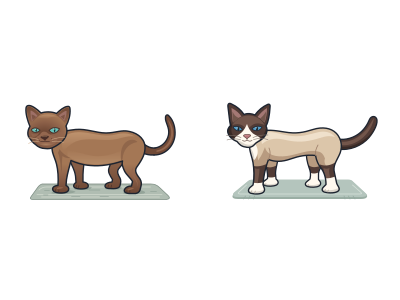
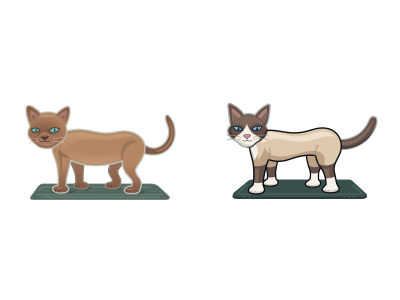
An exploration group
Siamese-influenced breeds
Selected breed-development histories
Three breeding histories with a Siamese connection
Branches combine study-specific genetic affinities and documented breed-development histories. They are browsing groups, not a complete pedigree or dated evolutionary tree. Crossbreeding connects different branches, and similar coats can arise independently.
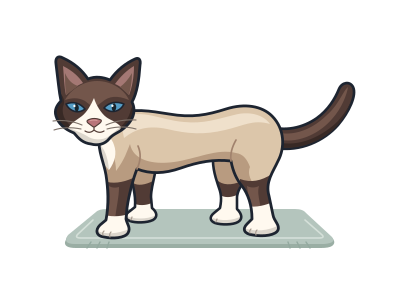
Return to the tree of life →Three different breeding programmes link these cats to the Siamese. Tonkinese development brought Siamese and Burmese cats together. Snowshoes were developed using Siamese and American Shorthair cats. Ocicat development involved Siamese and Abyssinian cats, with American Shorthairs contributing later. These connections come from documented breeding histories.
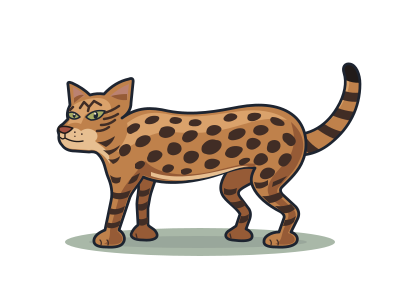
All three are breeds of domestic cat, not separate species. Despite its name, the Ocicat has no ocelot ancestry. This group follows breeding history rather than putting cats into one genetic group. In the 2018 study, the Ocicat showed intermediate genetic similarities rather than fitting neatly into an eastern group.
Read this part of the diagram as a guide to those separate histories. Neighbouring breeds are not shown as ancestors and descendants, and the layout does not establish a complete pedigree or dates. The documented crosses are separate evidence of how breeders developed these cats.
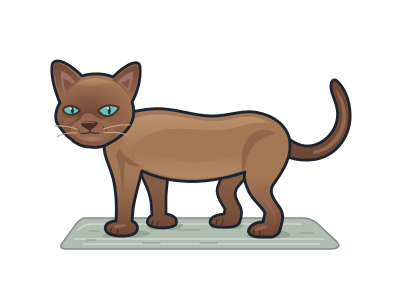
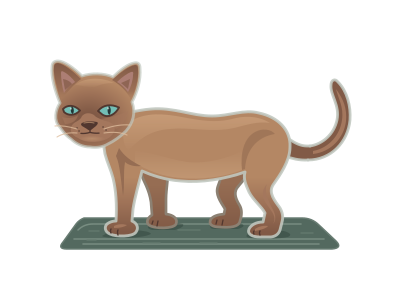
Aqua eyes
Tonkinese with the coat pattern called mink commonly have aqua eyes. Other coat patterns and eye colours also occur.
White-footed beginnings
Snowshoe development began in the United States in the 1960s with white-footed Siamese kittens.
An unexpected kitten
The Ocicat story began in 1964, when an attempt to produce Siamese cats with Abyssinian-style markings produced a spotted kitten.
Explore this group
Study attribution
Gandolfi et al. (2018), Scientific Reports 8:7024 · CC-BY-4.0. Original explanation of study-specific similarity; editorial group headings are explicitly not clades or geography of origin. No study photos imported.
CFA, TICA and GCCF breed histories. Original summaries of documented breeding programmes and registry distinctions. Per-page sources identify the relevant breed histories; no standards, source prose or photographs reproduced.
Gandolfi et al. (2010): Sphynx and Devon Rex mutations in KRT71. Independent factual explanation of distinct coat variants, not a breed pedigree. No source imagery or text reproduced.
Selection Signatures Reveal Candidate Genes for the Cornish Rex Breed-Specific Phenotype (2024). Factual contrast between LPAR6-associated Cornish coat and KRT71-associated Devon/Sphynx coats. No figures or measurements copied.
Selected facts/group membership adapted; simplified layout and illustrations by Lifetree.