A domestic breed
Ocicat
Felis catus
Ocelot-like spots, domestic roots
Branches combine study-specific genetic affinities and documented breed-development histories. They are browsing groups, not a complete pedigree or dated evolutionary tree. Crossbreeding connects different branches, and similar coats can arise independently.
Return to the tree of life →The first crosses were between Abyssinians and Siamese. Breeders later brought in American Shorthairs, which added a sturdier build and introduced silver colouring.
A 2018 study compared DNA from different cat breeds. On the study’s chart, the Ocicats sat between the central and Asian groups. The Siamese sat in the Asian group. The chart shows how similar the cats in the study were, not which cats were bred together.
Lifetree shows the Ocicat beside the Tonkinese and Snowshoe because Siamese cats helped found all three breeds. Being neighbours here doesn’t show that one breed came from another or tell you which two are most closely related.
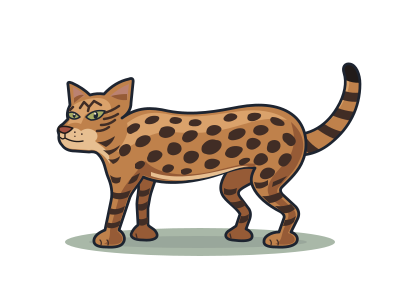
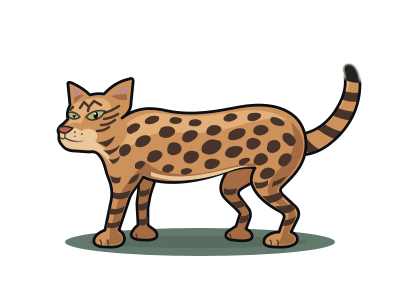
A typical Ocicat has a deep chest and an athletic build. The spots on its short coat look like dark thumbprints. On its sides, a spot can sit in a ring of others, like a target made of dots. Broken bands mark the lower legs, and dark bars cross the long tail.
Origins
Tonga was the first spotted kitten in the breeding programme. He was born in Michigan in the 1960s and inspired the breed’s name, but he was not used for breeding. Spotted kittens from later litters of the same parents helped found the breed.
Original purpose
Virginia Daly was trying to breed a Siamese with Abyssinian colouring on its face, ears, paws and tail. The spotted coat came as a surprise.
Recognition
The Cat Fanciers’ Association accepted the breed for registration in 1966. In 1987, it allowed Ocicats to compete for championships. Those dates mark two steps in one registry, not when the breed began.
Study attribution
Gandolfi et al. (2018), Scientific Reports 8:7024 · CC-BY-4.0. Original explanation of study-specific similarity; editorial group headings are explicitly not clades or geography of origin. No study photos imported.
CFA, TICA and GCCF breed histories. Original summaries of documented breeding programmes and registry distinctions. Per-page sources identify the relevant breed histories; no standards, source prose or photographs reproduced.
Gandolfi et al. (2010): Sphynx and Devon Rex mutations in KRT71. Independent factual explanation of distinct coat variants, not a breed pedigree. No source imagery or text reproduced.
Selection Signatures Reveal Candidate Genes for the Cornish Rex Breed-Specific Phenotype (2024). Factual contrast between LPAR6-associated Cornish coat and KRT71-associated Devon/Sphynx coats. No figures or measurements copied.
Selected facts/group membership adapted; simplified layout and illustrations by Lifetree.