A domestic breed
Snowshoe
Felis catus
Siamese roots, with white feet on the classic coat
Branches combine study-specific genetic affinities and documented breed-development histories. They are browsing groups, not a complete pedigree or dated evolutionary tree. Crossbreeding connects different branches, and similar coats can arise independently.
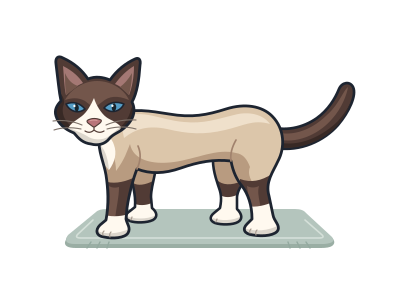
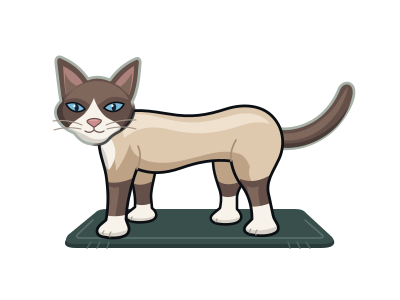
Return to the tree of life →American breeders developed the Snowshoe from Siamese cats and brought in American Shorthairs with white markings. The breed has blue eyes, short fur and a muscular build without being bulky. Its coat is usually lighter on the body than on the face, ears, legs and tail.
White feet stand out against the darker legs. One familiar pattern has a white patch that starts at the bridge of the nose and widens towards the chin like an upside-down V. Not every Snowshoe has that V, and white feet and similar colouring aren’t enough to tell what breed a cat is.
The diagram puts the Snowshoe beside the Tonkinese and Ocicat because breeders used Siamese cats to develop all three. It doesn’t show these neighbours as ancestors or descendants of one another, or tell us which breeds are closest to the Snowshoe by DNA.
Origins
In the early 1960s, Philadelphia breeder Dorothy Hinds-Daugherty found three kittens in a Siamese litter that each had four white feet.
Original purpose
Hinds-Daugherty wanted to keep the contrast that had caught her eye in those kittens: white markings against the darker parts of a Siamese coat.
Recognition
The Fédération Internationale Féline recognised the Snowshoe in 2004. That was this registry’s decision, not the year the breed began.
Study attribution
Gandolfi et al. (2018), Scientific Reports 8:7024 · CC-BY-4.0. Original explanation of study-specific similarity; editorial group headings are explicitly not clades or geography of origin. No study photos imported.
CFA, TICA and GCCF breed histories. Original summaries of documented breeding programmes and registry distinctions. Per-page sources identify the relevant breed histories; no standards, source prose or photographs reproduced.
Gandolfi et al. (2010): Sphynx and Devon Rex mutations in KRT71. Independent factual explanation of distinct coat variants, not a breed pedigree. No source imagery or text reproduced.
Selection Signatures Reveal Candidate Genes for the Cornish Rex Breed-Specific Phenotype (2024). Factual contrast between LPAR6-associated Cornish coat and KRT71-associated Devon/Sphynx coats. No figures or measurements copied.
Selected facts/group membership adapted; simplified layout and illustrations by Lifetree.