A domestic breed
Tonkinese
Felis catus
A build between Siamese and Burmese
Branches combine study-specific genetic affinities and documented breed-development histories. They are browsing groups, not a complete pedigree or dated evolutionary tree. Crossbreeding connects different branches, and similar coats can arise independently.
Return to the tree of life →Breeders developed the modern Tonkinese by crossing Siamese and Burmese cats. They crossed two breeds of the same species. Breed standards describe a muscular cat with a build between the two: not as long and slender as the Siamese or as compact as the Burmese.
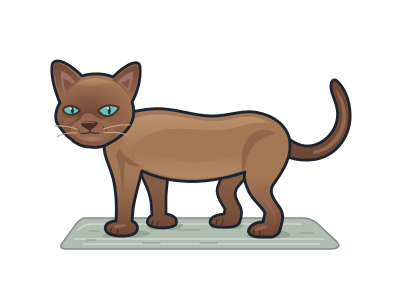
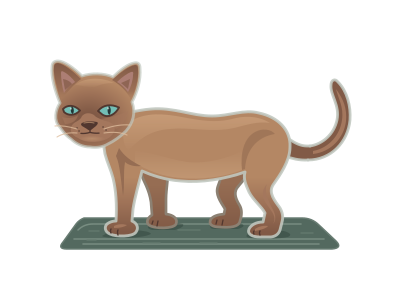
The cat shown here has a mink coat and blue-green eyes. Dark brown on the face, ears, feet and tail blends into the lighter brown body. In the pointed pattern, the darker areas stand out more and the eyes are typically blue. In the solid pattern, the darker areas are harder to pick out, and the eyes can be green or yellow-green.
The diagram places the Tonkinese beside the Snowshoe and Ocicat to help you browse. That layout doesn’t tell you which breeds are closest genetically or whether one neighbour descended from another. The Siamese–Burmese crosses are known from breeding records, not from where the breeds sit in the diagram.
Origins
In the mid-1960s, Jane Barletta in New Jersey and Margaret Conroy in Canada began separate breeding programmes. They later worked together to write the first description of what the breed should look like.
Original purpose
Margaret Conroy chose a Siamese mate for her Burmese rather than send her cat away for breeding. The kittens’ tan coats and blue-green eyes caught her attention, and she began breeding for that colouring.
Recognition
The Cat Fanciers’ Association admitted mink Tonkinese to championship competition in 1984. Pointed and solid Tonkinese followed in 2002. Those dates mark changes to show rules, not the start of the breed.
Study attribution
Gandolfi et al. (2018), Scientific Reports 8:7024 · CC-BY-4.0. Original explanation of study-specific similarity; editorial group headings are explicitly not clades or geography of origin. No study photos imported.
CFA, TICA and GCCF breed histories. Original summaries of documented breeding programmes and registry distinctions. Per-page sources identify the relevant breed histories; no standards, source prose or photographs reproduced.
Gandolfi et al. (2010): Sphynx and Devon Rex mutations in KRT71. Independent factual explanation of distinct coat variants, not a breed pedigree. No source imagery or text reproduced.
Selection Signatures Reveal Candidate Genes for the Cornish Rex Breed-Specific Phenotype (2024). Factual contrast between LPAR6-associated Cornish coat and KRT71-associated Devon/Sphynx coats. No figures or measurements copied.
Selected facts/group membership adapted; simplified layout and illustrations by Lifetree.