A domestic breed
Tibetan Spaniel
Canis lupus familiaris
Fringed ears and a form of its own.
Branches show genetic similarity, not direct ancestors or dated splits. Crossbreeding connects different branches.
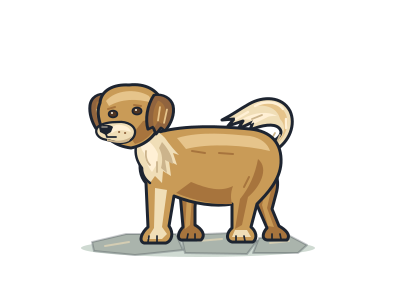
Return to the tree of life →Shown beside the Shih Tzu, Pekingese and Japanese Chin, the Tibetan Spaniel is a dog breed with a recognisable form of its own. Look for hanging ears edged with longer hair, oval dark-brown eyes and a blunt muzzle that projects clearly from the face. The breed standard describes a small head and a muzzle without wrinkles.
The breed's history includes a documented chapter in Britain. Tibetan Spaniels arrived there in late Victorian times, but their numbers grew mainly after the Second World War. Dogs brought back by the Wakefield and Hawkins families helped establish the breed. Britain's Tibetan Spaniel Association was formed in 1957.
The tree's neighbours reflect genetic similarities found in one study, not a family record of individual dogs. This display does not mean that the Tibetan Spaniel descended from any of the modern breeds beside it.
Origins
The breed comes from Tibet. The international dog registry, the FCI, lists this as its place of origin.
Original purpose
Breed histories describe Tibetan monks keeping these small dogs as companions and watchdogs in monasteries.
Recognition
The American Kennel Club recognised the breed in 1983. That is a registry milestone, not its origin date.
Study attribution
Parker et al. (2017), Cell Reports 19:697–708 · CC-BY-4.0. Selected clade membership and nested Figure 1 relationships restated as a new, simplified diagram. No photographs, branch lengths or bootstrap values copied.
Selected facts/group membership adapted; simplified layout and illustrations by Lifetree.