A domestic breed
Japanese Chin
Canis lupus familiaris
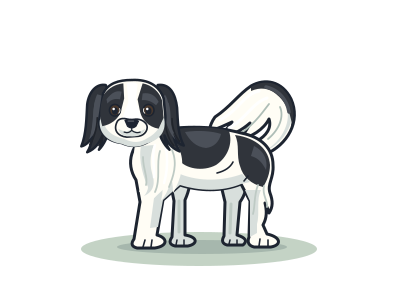
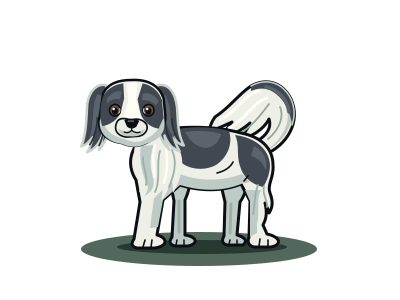
A small dog with a square outline and a flowing tail.
Branches show genetic similarity, not direct ancestors or dated splits. Crossbreeding connects different branches.
Return to the tree of life →The Japanese Chin has a compact, roughly square outline: its body is about as long as it is tall at the shoulder. Its broad head has a short, wide muzzle and rounded cheeks. The triangular ears hang down, with long fringes of hair along their edges.
Straight, silky hair grows especially long around the ears, neck, thighs and tail. The tail arches over the back like a flowing spray of hair. Black-and-white dogs have coloured markings around the eyes and ears, often separated by a broad white stripe up the face. Their narrow, elongated feet can have tufts of hair at the toes.
On this explorer, the breed sits beside the Shih Tzu, Pekingese and Tibetan Spaniel. These are all domestic dog breeds, not separate species. Their grouping comes from one study of dog relationships. It does not mean that the Japanese Chin descended from any of these neighbouring modern breeds.
Origins
The breed was developed in Japan. The Royal Kennel Club traces its earlier roots to China.
Original purpose
These dogs were companions and lapdogs in wealthy Japanese households, rather than hunting or herding dogs.
Recognition
The American Kennel Club recognised the breed in 1888. This marks registry recognition, not when the breed began.
Study attribution
Parker et al. (2017), Cell Reports 19:697–708 · CC-BY-4.0. Selected clade membership and nested Figure 1 relationships restated as a new, simplified diagram. No photographs, branch lengths or bootstrap values copied.
Selected facts/group membership adapted; simplified layout and illustrations by Lifetree.