A domestic breed
Pekingese
Canis lupus familiaris
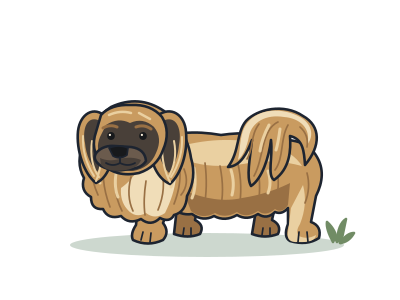
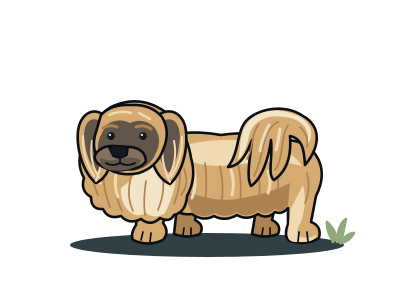
A small dog with a lion-like mane.
Branches show genetic similarity, not direct ancestors or dated splits. Crossbreeding connects different branches.
Return to the tree of life →With its lion-like mane and low, compact body, the Pekingese has a recognisable outline. It is a domestic dog breed, not a separate species. Here it appears beside the Shih Tzu, Tibetan Spaniel and Japanese Chin. These are neighbours in a group based on similarities found in one study, not a line of ancestors. The layout does not trace parentage between these breeds.
Beneath the coat, the body has a broad, heavier front and a narrower, lighter back end. Straight outer hair lies over a thick, soft layer underneath. Longer hair frames the neck and shoulders, while the tail curves over the back. Some dogs have a dark facial mask; others have a face that matches their coat colour.
The breed’s appearance has changed over time. The American Kennel Club’s historical account describes modern dogs as having shorter legs and faces, and longer coats, than palace dogs pictured more than a century earlier. Pekingese reached Britain following the looting of Beijing’s imperial palace complex in 1860. That records their arrival there, not the breed’s creation.
Origins
The breed comes from China. Its name refers to Peking, the city now called Beijing.
Original purpose
Pekingese were bred as companions to the Chinese imperial family.
Recognition
The American Kennel Club recognised the breed in 1906. This was a registration milestone, not its origin date.
Study attribution
Parker et al. (2017), Cell Reports 19:697–708 · CC-BY-4.0. Selected clade membership and nested Figure 1 relationships restated as a new, simplified diagram. No photographs, branch lengths or bootstrap values copied.
Selected facts/group membership adapted; simplified layout and illustrations by Lifetree.