A domestic breed
Shih Tzu
Canis lupus familiaris
A sturdy little dog beneath a flowing coat.
Branches show genetic similarity, not direct ancestors or dated splits. Crossbreeding connects different branches.
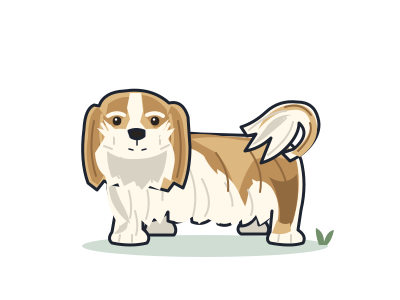
Return to the tree of life →The Shih Tzu is a small, sturdy dog breed beneath a long, flowing coat. On this tree it appears beside the Pekingese, Tibetan Spaniel and Japanese Chin. These neighbours reflect genetic similarities found in one study. Their positions do not mean that one modern breed gave rise to another.
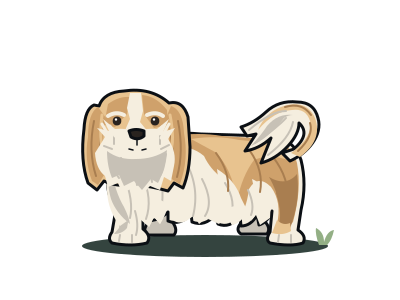
Look closely at the face. Hair grows upwards around the muzzle, giving it an outline often compared with a chrysanthemum flower. The eyes are round, usually very dark and set well apart. They should not bulge. Beneath all that hair, the body is slightly longer than it is tall.
The full coat has two layers, with long outer hair that may have a slight wave. A richly haired tail curves over the back. Together, the flowing coat, flower-like face and solid body give this breed its recognisable outline.
Origins
The breed has Tibetan roots and was developed in China, where dogs of this type lived in imperial palaces.
Original purpose
Shih Tzu were kept as companions in the Chinese royal court, rather than developed for hunting or herding.
Recognition
The American Kennel Club recognised the breed in 1969. This was a registry milestone, not its date of origin.
Study attribution
Parker et al. (2017), Cell Reports 19:697–708 · CC-BY-4.0. Selected clade membership and nested Figure 1 relationships restated as a new, simplified diagram. No photographs, branch lengths or bootstrap values copied.
Selected facts/group membership adapted; simplified layout and illustrations by Lifetree.