A domestic breed
Standard Schnauzer
Canis lupus familiaris
German working dogs that helped shape the Miniature and Giant Schnauzers
Branches show genetic similarity, not direct ancestors or dated splits. Crossbreeding connects different branches.
Return to the tree of life →The Schnauzer Club of NSW traces the Miniature and Giant back in part to the older, standard-sized dogs. Breeders crossed those dogs with other dogs to develop the smaller and larger breeds. Today the Standard, Miniature and Giant are three separate breeds. The older working dogs came before the modern registered breeds.
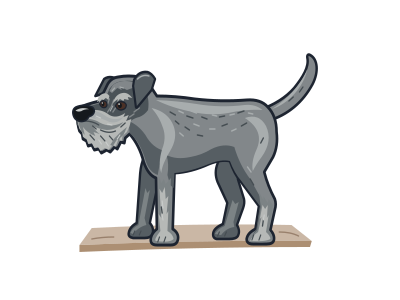
An adult Standard looks almost square from the side: its body is about as long as it is tall at the shoulder. A wiry beard and bushy eyebrows frame a long head. The natural ears fold forwards in a V, and the full tail can curve upwards.
A 2017 DNA study grouped the Standard and Miniature together. Their branches show how similar the DNA of the dogs in the study was. The diagram does not show one breed as the ancestor of the other or give dates for splits. Crossbreeding can link breeds on different branches, and the diagram does not trace every past cross.
Origins
When Germany’s Pinscher Club formed in 1895, it listed the breed as the rough-haired Pinscher.
Original purpose
In southern Germany, these dogs caught rats and other rodents in horse stables.
Recognition
The American Kennel Club recognised the Standard Schnauzer in 1904. The breed already existed before then.
Study attribution
Parker et al. (2017), Cell Reports 19:697–708 · CC-BY-4.0. Selected clade membership and nested Figure 1 relationships restated as a new, simplified diagram. No photographs, branch lengths or bootstrap values copied.
Selected facts/group membership adapted; simplified layout and illustrations by Lifetree.