A domestic breed
Miniature Schnauzer
Canis lupus familiaris
A smaller breed with a Standard Schnauzer connection
Branches show genetic similarity, not direct ancestors or dated splits. Crossbreeding connects different branches.
Return to the tree of life →The Miniature Schnauzer is a breed in its own right, not just a small Standard Schnauzer. The American Kennel Club’s breed history describes breeders using smaller Standard Schnauzers alongside other dogs. A bearded dog in an old painting may show an earlier local type. Its looks alone cannot tell us whether it was an ancestor of today’s breed.
The study behind this exhibit grouped the Miniature and Standard Schnauzers together because of similarities in the DNA of the dogs studied. The diagram does not show one breed descending from the other or give dates for the branches. Across the wider dog tree, the researchers found evidence of crosses between breeds on different branches.
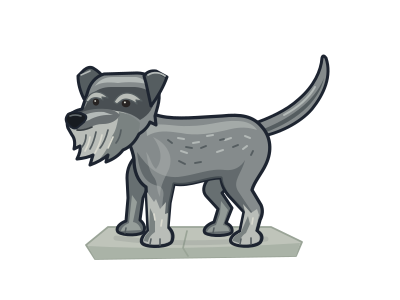
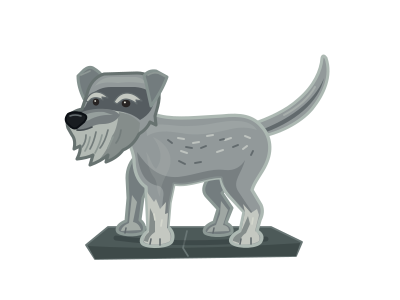
A typical adult is sturdy, with a muzzle that ends bluntly, a full beard and bushy brows. The outer coat is wiry. The natural ears fold forwards, and an uncut tail can curve upwards.
Origins
The international kennel federation describes an early form from near Frankfurt am Main, Germany, around 1900. It was then known as a rough-haired miniature pinscher.
Original purpose
These dogs were bred to hunt rats and other small pests. They also kept people company at home.
Recognition
The breed first became eligible for American Kennel Club registration in 1926. That marks its recognition in the US, not the start of the breed.
Study attribution
Parker et al. (2017), Cell Reports 19:697–708 · CC-BY-4.0. Selected clade membership and nested Figure 1 relationships restated as a new, simplified diagram. No photographs, branch lengths or bootstrap values copied.
Selected facts/group membership adapted; simplified layout and illustrations by Lifetree.