A domestic breed
Siberian Husky
Canis lupus familiaris
A familiar outline with a varied look
Branches show genetic similarity, not direct ancestors or dated splits. Crossbreeding connects different branches.
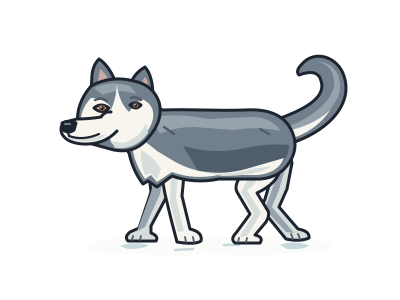
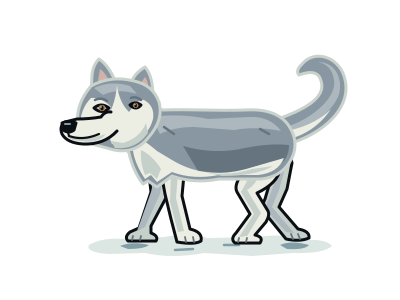
Return to the tree of life →The Siberian Husky is recognisable by its upright ears, thick coat and bushy tail—but these dogs do not all look alike. Coats can be black-and-white, grey-and-white, red-and-white or entirely white. Facial markings vary too: there is no compulsory mask. The tail normally hangs down at rest and may rise in a loose curve when the dog is attentive.
Records trace important steps in the breed's development. William Goosak brought Siberian dogs to Nome, Alaska, in 1908 for the following year's racing season. In 1910, a team driven by John Johnson won the All Alaska Sweepstakes, a race of about 660 kilometres. Leonhard Seppala and Elizabeth Ricker later established a kennel in Maine in 1927, helping develop the registered breed in North America.
On this tree, the Husky sits beside the Akita, Shiba Inu and Alaskan Malamute within a study-specific similarity group. These neighbours are other domestic dog breeds; their placement does not establish its ancestors. Their position is a way to explore similarities, not a family pedigree.
Origins
The breed's roots lie with the sled dogs of the Chukchi people in north-eastern Siberia.
Original purpose
These dogs pulled light loads in harness over long distances at moderate speeds, rather than hauling the heaviest freight.
Recognition
The American Kennel Club recognised the breed in 1930. This was registry recognition, not the beginning of its history.
Study attribution
Parker et al. (2017), Cell Reports 19:697–708 · CC-BY-4.0. Selected clade membership and nested Figure 1 relationships restated as a new, simplified diagram. No photographs, branch lengths or bootstrap values copied.
Selected facts/group membership adapted; simplified layout and illustrations by Lifetree.