A domestic breed
Shiba Inu
Canis lupus familiaris
Upright ears, full cheeks and a high-set tail
Branches show genetic similarity, not direct ancestors or dated splits. Crossbreeding connects different branches.
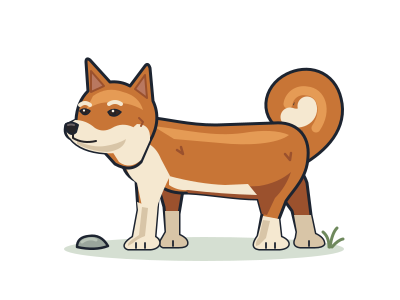
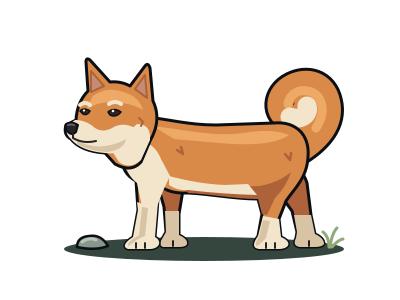
Return to the tree of life →Upright triangular ears, full cheeks and a thick, high-set tail give the Shiba Inu its recognisable outline. The tail curls over the back or forms an open curve. Dark brown eyes sit above a well-developed snout that narrows towards the nose. Adults are sturdy and muscular, with a body slightly longer than their shoulder height.
Efforts to preserve the breed were under way by 1928. After the Second World War, surviving dogs from different regions were bred together to rebuild the breed. Today, Shibas are mainly kept as companion dogs in Japan and the United States.
Here, the Shiba sits alongside the Akita and other dogs in a study-specific similarity grouping. This is not a pedigree: neighbouring modern breeds are not shown as ancestors of one another. The Shiba is a domestic dog breed, not a separate species or a miniature Akita.
Origins
The breed developed in Japan. Regional forms included Mino, Sanin and Shinshu.
Original purpose
Shibas were bred to drive birds and small animals out of cover for hunters.
Recognition
The American Kennel Club recognised the breed in 1992. This was a registration milestone, not its origin.
Study attribution
Parker et al. (2017), Cell Reports 19:697–708 · CC-BY-4.0. Selected clade membership and nested Figure 1 relationships restated as a new, simplified diagram. No photographs, branch lengths or bootstrap values copied.
Selected facts/group membership adapted; simplified layout and illustrations by Lifetree.