A domestic breed
Akita
Canis lupus familiaris
A sturdy dog with upright ears and a curled tail
Branches show genetic similarity, not direct ancestors or dated splits. Crossbreeding connects different branches.
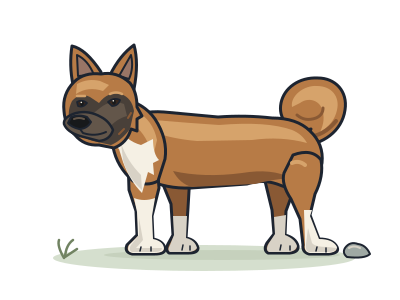
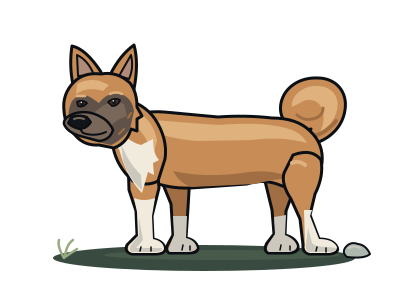
Return to the tree of life →With a broad head, upright ears and a large tail curled over its back, the Akita has a sturdy outline. Its body is slightly longer than its height at the shoulder, with a deep chest and substantial legs. Here, its appearance and size follow the American-form standards.
That outline has a documented history of change. From 1868, regional Akita dogs were crossed with Tosas and Mastiffs, increasing their size. Nine Akitas were designated Natural Monuments in Japan in 1931. Japanese and American breeding programmes later developed different forms, with different rules for coat colours and adult size.
On this tree, the Akita sits in the study's Asian spitz group, near the Shiba Inu, Siberian Husky and Alaskan Malamute. These are neighbouring breeds, not steps in a pedigree. Their positions do not mean that one modern breed descended from another, or tell us when breeds developed.
Origins
The breed's roots are in the Akita region of Japan.
Original purpose
Akitas were bred as hunting dogs in the rugged mountains of northern Japan.
Recognition
The American Kennel Club first recognised the Akita in 1972. This was a registry milestone, not the breed's origin date.
Study attribution
Parker et al. (2017), Cell Reports 19:697–708 · CC-BY-4.0. Selected clade membership and nested Figure 1 relationships restated as a new, simplified diagram. No photographs, branch lengths or bootstrap values copied.
Selected facts/group membership adapted; simplified layout and illustrations by Lifetree.