A domestic breed
Shetland Sheepdog
Canis lupus familiaris
A Collie-like outline, with a history of its own.
Branches show genetic similarity, not direct ancestors or dated splits. Crossbreeding connects different branches.
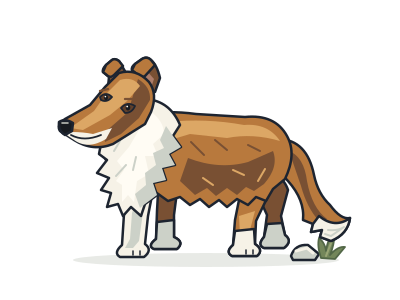
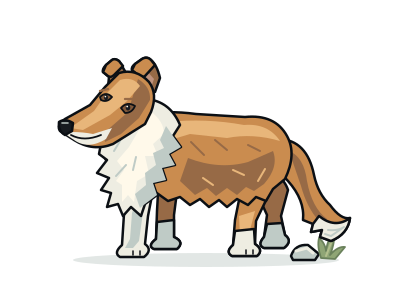
Return to the tree of life →The Shetland Sheepdog may look like a small Rough Collie, but it is a distinct breed, not simply a miniature version. Its long, straight coat forms a full mane around the neck. It has a tapering snout and small ears. When alert, its ears stand partly upright with their tips folded forwards.
People helped shape that outline. In the early 1900s, breed clubs formed and written descriptions of the ideal dog helped guide the modern breed’s development. Historical breeders crossed some small island dogs with show Collies to develop a more consistent appearance. That documented breeding history matters, but it is separate from this diagram.
Here, the Shetland Sheepdog appears beside the Border Collie, Collie and Australian Shepherd in a group based on genetic similarities in one study. Their positions do not show a chain of ancestors and descendants. Nor do they show when breeds separated. The layout explores similarities; it does not record parentage or rule out documented historical crosses.
Origins
The breed comes from the Shetland Islands, off Scotland’s north-east coast.
Original purpose
These all-purpose farm dogs kept livestock away from gardens and helped farmers gather sheep.
Recognition
The American Kennel Club recognised the breed in 1911. This is a registry milestone, not the date the breed originated.
Study attribution
Parker et al. (2017), Cell Reports 19:697–708 · CC-BY-4.0. Selected clade membership and nested Figure 1 relationships restated as a new, simplified diagram. No photographs, branch lengths or bootstrap values copied.
Selected facts/group membership adapted; simplified layout and illustrations by Lifetree.