A domestic breed
Collie
Canis lupus familiaris
A familiar outline, with more than one coat
Branches show genetic similarity, not direct ancestors or dated splits. Crossbreeding connects different branches.
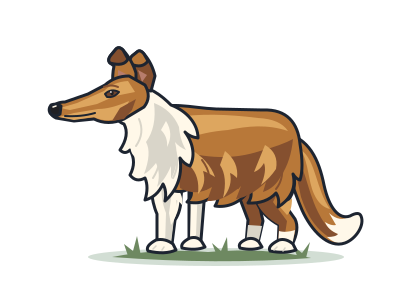
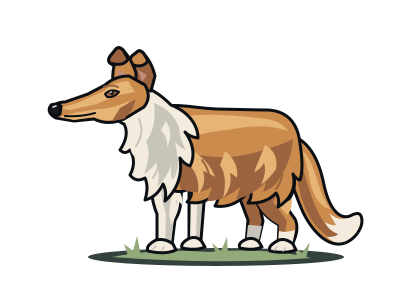
Return to the tree of life →The Collie has a long head and ear tips that fold forwards when alert. Its familiar flowing coat belongs to the Rough form. This long-haired form has straight outer hairs over a soft layer underneath, with especially thick hair around the neck. The Smooth form has a short coat instead.
The breed’s documented development includes changes in the show ring. Separate British show classes for rough-coated and smooth-coated sheepdogs appeared in 1870. Queen Victoria also kept Collies, bringing dogs from Balmoral to other royal estates, including Windsor. These records describe parts of its history, not a single founding moment.
Here, the Collie appears beside the Border Collie, Shetland Sheepdog and Australian Shepherd. This study-specific grouping shows similarities, not a family pedigree. Neighbouring positions do not establish that one breed descended from another. The diagram gives no dates for shared ancestry, and its line lengths are not measurements. Documented breed development must be considered separately.
Origins
The Rough Collie developed from working sheepdogs of Scotland, sharing these roots with the Smooth Collie.
Original purpose
Dogs of this type herded sheep and guarded flocks.
Recognition
The American Kennel Club recognised the Collie in 1885. This was a registry milestone, not the breed’s origin date.
Study attribution
Parker et al. (2017), Cell Reports 19:697–708 · CC-BY-4.0. Selected clade membership and nested Figure 1 relationships restated as a new, simplified diagram. No photographs, branch lengths or bootstrap values copied.
Selected facts/group membership adapted; simplified layout and illustrations by Lifetree.