A domestic breed
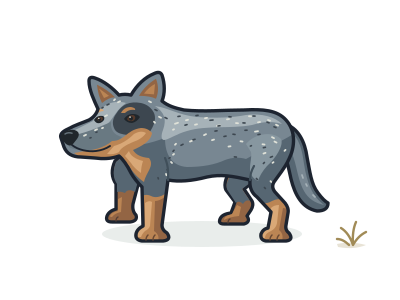
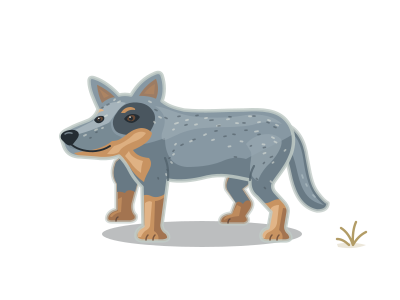
Australian Cattle Dog
Canis lupus familiaris
An Australian working breed that sits near collies and corgis in the DNA diagram.
Branches show genetic similarity, not direct ancestors or dated splits. Crossbreeding connects different branches.
Return to the tree of life →The dogs that came before this breed worked in the cattle country of eastern Australia. By 1903, a New South Wales farming journal had published an early guide to what the breed should look like. The working dogs came before the written rules.
A typical adult is compact and muscular, with a deep chest and a level back. Its body is a little longer than it is tall at the shoulder. Look for upright ears set wide apart, a sturdy snout that narrows towards a black nose, and a long, brushy tail. The short coat can be blue-grey or speckled red.
The 2017 DNA study placed this breed in a group called UK Rural, alongside the Border Collie, Australian Shepherd and Old English Sheepdog. The name doesn’t mean every breed in the group came from the UK. The diagram groups breeds by similarities in the DNA the researchers compared. It doesn’t tell us whether one breed helped form another or when the branches split. Crossbreeding can connect breeds on different branches.
Origins
Breed histories trace the breed to Hall’s Heelers, working dogs bred by cattleman Thomas Simpson Hall in the Upper Hunter Valley of New South Wales.
Original purpose
In the 19th century, people bred these dogs to gather hard-to-handle cattle and move them long distances over rough ground.
Recognition
The international kennel federation, known as the FCI, gave the breed full recognition in 1972.
Study attribution
Parker et al. (2017), Cell Reports 19:697–708 · CC-BY-4.0. Selected clade membership and nested Figure 1 relationships restated as a new, simplified diagram. No photographs, branch lengths or bootstrap values copied.
Selected facts/group membership adapted; simplified layout and illustrations by Lifetree.