A domestic breed
Old English Sheepdog
Canis lupus familiaris
A shaggy breed with working roots
Branches show genetic similarity, not direct ancestors or dated splits. Crossbreeding connects different branches.
Return to the tree of life →The breed’s working roots go back beyond its show records. Old English Sheepdogs were shown in Birmingham in 1873, and a British club for the breed formed in 1888. By the late 1800s, breeders were putting in writing what judges should look for.
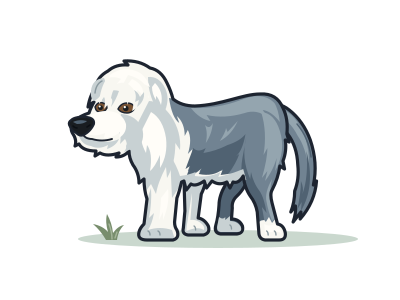
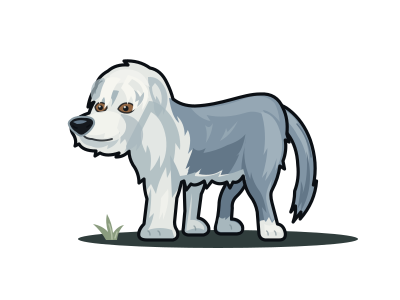
Beneath the shaggy coat is a sturdy, compact dog with a broad, square muzzle and ears that lie flat against the head. A familiar adult pattern is blue-grey across the back and rump, with white on the head, chest and front legs.
The DNA study calls this broad group UK Rural. That name doesn’t mean every breed in it came from the UK. Nearby branches show similarities in DNA. They don’t tell us whether one breed came from another or when breeds split. Dogs from different branches can have shared ancestors through crossbreeding.
Origins
The breed is thought to have developed in western England, especially in Devon, Somerset and Cornwall.
Original purpose
Despite the name, these dogs helped take cattle as well as sheep to market.
Recognition
The Fédération Cynologique Internationale gave the breed full recognition on 25 November 1963. The breed already existed by then.
Study attribution
Parker et al. (2017), Cell Reports 19:697–708 · CC-BY-4.0. Selected clade membership and nested Figure 1 relationships restated as a new, simplified diagram. No photographs, branch lengths or bootstrap values copied.
Selected facts/group membership adapted; simplified layout and illustrations by Lifetree.