A domestic breed
Italian Greyhound
Canis lupus familiaris
A small Italian breed with the outline of a Greyhound
Branches show genetic similarity, not direct ancestors or dated splits. Crossbreeding connects different branches.
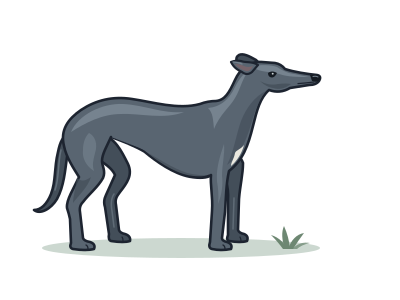
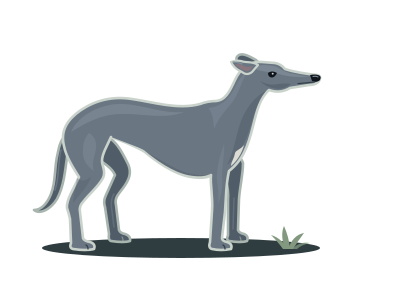
Return to the tree of life →The Italian Greyhound may look like a young Greyhound, but it is a small breed in its own right. Seen from the side, an adult’s body is about as long as it is tall at the shoulder. Its narrow chest reaches its elbows, its belly sweeps up behind the ribs, and its low tail tapers and curves towards the tip.
Old paintings can show what earlier dogs looked like, but they cannot prove a family line to today’s registered breed. A clearer chapter came after the Second World War, when Italian breeders helped rebuild the breed with support from breeders in Austria, Germany and France.
A 2017 study placed the breed in a broad group called UK Rural. That is a study label, not a claim that the breed came from Britain. This exhibit shows how similar the dogs studied were. It does not date splits or show one neighbouring breed as the ancestor of another. Breeds on different branches can still have a history of crossbreeding.
Origins
In Renaissance Italy, small dogs with the build of a Greyhound became fashionable at noble courts.
Original purpose
Italy’s kennel club records two historical roles: keeping people company and hunting wild rabbits. This small sighthound relied mainly on sight to spot and chase rabbits.
Recognition
The Fédération Cynologique Internationale gave the breed full recognition on 22 October 1956. It lists the breed as Piccolo Levriero Italiano, or Italian Sighthound. That is a recognition date, not an origin date.
Study attribution
Parker et al. (2017), Cell Reports 19:697–708 · CC-BY-4.0. Selected clade membership and nested Figure 1 relationships restated as a new, simplified diagram. No photographs, branch lengths or bootstrap values copied.
Selected facts/group membership adapted; simplified layout and illustrations by Lifetree.