A domestic breed
Borzoi
Canis lupus familiaris
A long-legged Russian hunting breed with a Greyhound connection
Branches show genetic similarity, not direct ancestors or dated splits. Crossbreeding connects different branches.
Return to the tree of life →Russian breeders developed the Borzoi from several older types of hunting dog. The FCI’s breed history says crosses with Greyhounds helped shape one of those types. Those early hunting dogs came before the modern registered breed.
A 2017 study grouped the dogs it tested by similarities in their DNA. It placed the Borzoi in a group called ‘UK Rural’, but that label does not mean the breed came from Britain. The exhibit shows the Greyhound, Whippet, Irish Wolfhound, Scottish Deerhound and Italian Greyhound nearby. The branches don’t show one neighbouring breed as the direct ancestor of another. They don’t date splits or trace all the crosses between branches.
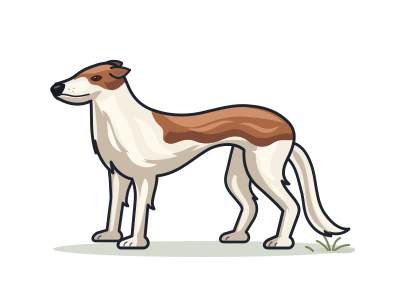
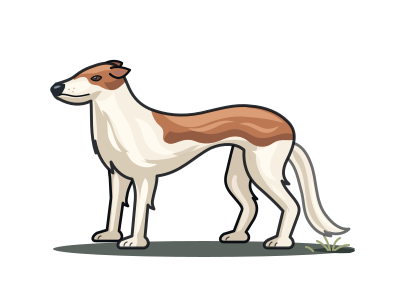
An adult Borzoi is tall and lean, with a deep chest, a back that rises in a curve and a belly that tucks up towards the hind legs. Its silky coat can lie flat, wave or curl.
Origins
The FCI’s breed history records that in 1888 the Moscow Hunting Society agreed on a written description of what the Borzoi should look like.
Original purpose
Borzoi were bred to chase hares, foxes and wolves across open ground. They relied mainly on sight rather than smell.
Recognition
The Fédération Cynologique Internationale (FCI) gave the Borzoi full recognition on 13 January 1956. That’s when the federation accepted the breed, not when it began.
Study attribution
Parker et al. (2017), Cell Reports 19:697–708 · CC-BY-4.0. Selected clade membership and nested Figure 1 relationships restated as a new, simplified diagram. No photographs, branch lengths or bootstrap values copied.
Selected facts/group membership adapted; simplified layout and illustrations by Lifetree.