A domestic breed
Scottish Deerhound
Canis lupus familiaris
A shaggy Highland hound that helped shape the Irish Wolfhound
Branches show genetic similarity, not direct ancestors or dated splits. Crossbreeding connects different branches.
Return to the tree of life →In the study behind this exhibit, the two hounds are grouped together in a larger group that also includes the Shetland Sheepdog. The branches show similarities among the dogs sampled. They don’t show one modern breed as the direct ancestor of another or tell us when breeds split. Crossbreeding can connect breeds on different branches.
Breeding records tell us something the diagram can’t. In the 1800s, Captain George Augustus Graham used Scottish Deerhounds alongside other dogs in a breeding programme that helped shape the modern Irish Wolfhound.
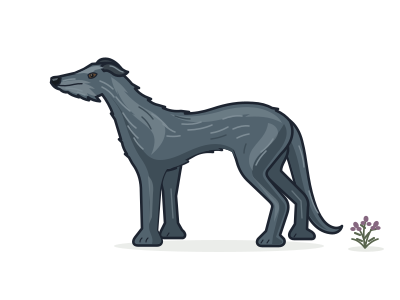
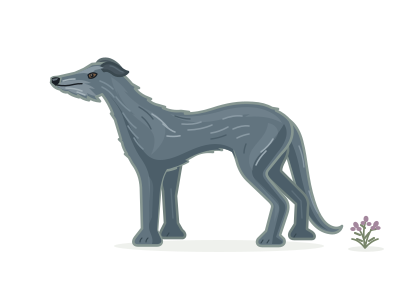
A typical Scottish Deerhound has the outline of a Greyhound, but on a larger, sturdier frame. Look for a deep chest, an arch over the lower back and a shaggy moustache. The small ears fold back at rest. The long tail narrows towards the tip and reaches almost to the ground when it hangs down.
Origins
The modern breed took shape from older Scottish working hounds. In 1892, Britain’s Deerhound Club approved a written description of what a Deerhound should look like.
Original purpose
Hunters bred these hounds to chase wild red deer across the rugged Scottish Highlands. The dogs needed speed as well as stamina to keep up the chase.
Recognition
The Fédération Cynologique Internationale lists the breed as the Deerhound. It gave the breed full recognition on 29 April 1955. That marks the organisation’s decision, not the start of the breed.
Study attribution
Parker et al. (2017), Cell Reports 19:697–708 · CC-BY-4.0. Selected clade membership and nested Figure 1 relationships restated as a new, simplified diagram. No photographs, branch lengths or bootstrap values copied.
Selected facts/group membership adapted; simplified layout and illustrations by Lifetree.