A domestic breed
Irish Wolfhound
Canis lupus familiaris
An Irish hound with a close Scottish relative
Branches show genetic similarity, not direct ancestors or dated splits. Crossbreeding connects different branches.
Return to the tree of life →In 2017, researchers compared DNA from many dog breeds and placed the two hounds in a group they called ‘UK Rural’. That name labels a DNA group, not a birthplace. The branches don’t show that one breed descended from the other or tell us when breeds split. Breeding records can show crosses that the branches don’t.
By the 1800s, the older Irish hounds had become scarce. They were a local type of dog. The modern breed got its first written standard in 1885, setting out what the dogs should look like.
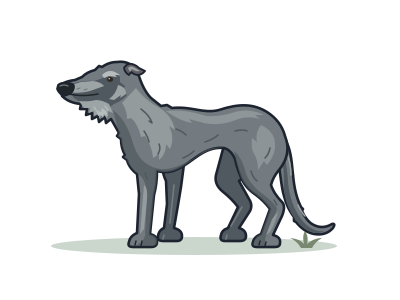
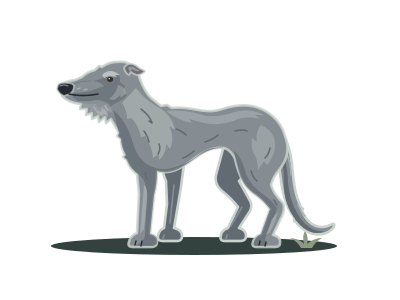
A typical adult has long legs, a deep chest and a long head. Wiry hair forms shaggy eyebrows and a beard. The small ears fold back at rest, and the long tail curves slightly at the tip. The rough coat can be grey, black, red or several other colours.
Origins
The modern breed took shape in the 1800s. Working in England, Captain George Augustus Graham used dogs thought to descend from older Irish hounds. His breeding programme included crosses with Scottish Deerhounds and Great Danes.
Original purpose
In Ireland, the older hounds were used to hunt wolves, wild boar and deer.
Recognition
The American Kennel Club recognised the breed in 1897. That was the date of recognition by that club, not the start of the breed.
Study attribution
Parker et al. (2017), Cell Reports 19:697–708 · CC-BY-4.0. Selected clade membership and nested Figure 1 relationships restated as a new, simplified diagram. No photographs, branch lengths or bootstrap values copied.
Selected facts/group membership adapted; simplified layout and illustrations by Lifetree.