A domestic breed
Gordon Setter
Canis lupus familiaris
Scotland’s black-and-tan setter
Branches show genetic similarity, not direct ancestors or dated splits. Crossbreeding connects different branches.
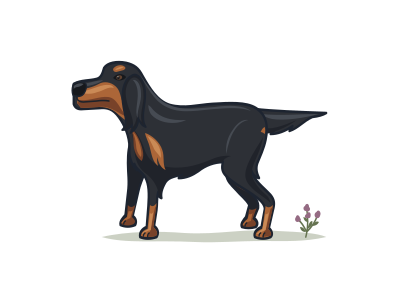
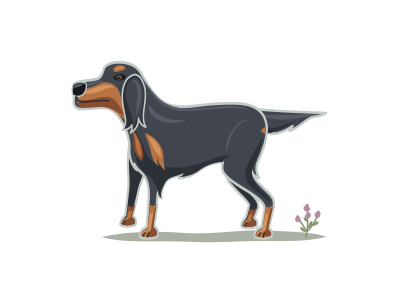
Return to the tree of life →Today’s Gordon Setter has a deep chest, ears that hang close to its head and a glossy black coat. Look for a chestnut-tan spot above each eye. In the mid-1800s, many of the setters at Gordon Castle had white in their coats as well as black, and some also had tan markings. The white was thought to make the dogs easier to spot at work.
Records describe black-and-tan working setters in England before the breeding programme at Gordon Castle. Dogs from those older working lines helped shape the breed that kennel clubs later registered.
A study comparing dogs’ DNA put the Gordon, Irish and English Setters in the same broad group. The branches show similarities among the dogs studied. They don’t show that one neighbouring breed came from another or give dates for the splits. Crossbreeding can connect different branches, so the diagram alone can’t confirm or rule out a particular historical cross.
Origins
Alexander Gordon, the fourth Duke of Gordon, developed a line of setters at Gordon Castle in Scotland in the early 1800s. The breed takes its name from him.
Original purpose
Gordon Setters were bred to find grouse on the heather-covered moors of the Scottish Highlands. They searched back and forth for the birds’ scent, then held still to show the hunter where a bird was.
Recognition
The FCI, an international federation of kennel clubs, granted the breed full recognition on 28 May 1963. The breed had already existed for many years.
Study attribution
Parker et al. (2017), Cell Reports 19:697–708 · CC-BY-4.0. Selected clade membership and nested Figure 1 relationships restated as a new, simplified diagram. No photographs, branch lengths or bootstrap values copied.
Selected facts/group membership adapted; simplified layout and illustrations by Lifetree.