A domestic breed
German Shorthaired Pointer
Canis lupus familiaris
A German hunting breed on the pointer and setter branch
Branches show genetic similarity, not direct ancestors or dated splits. Crossbreeding connects different branches.
Return to the tree of life →A 2017 study compared DNA from 161 dog breeds. It grouped this breed with the Weimaraner, Vizsla and several setters. The branches show DNA similarities in the dogs studied. They don’t tell us whether one neighbouring breed came from another or when breeds split.
The diagram leaves out some historical crosses. For example, breed records describe crosses with black English Pointers in the early 1900s.
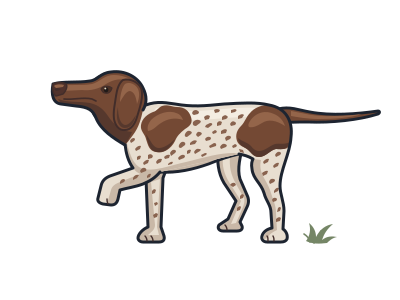
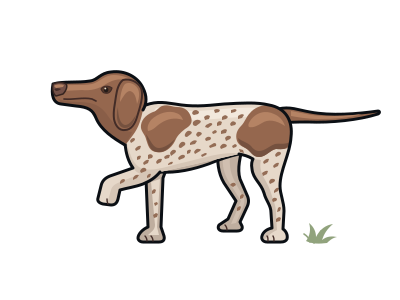
Adults have a deep chest and broad ears that hang close to the head. A full natural tail tapers and can reach about as far as the ankles of the back legs. The coat is short and dense. One pattern has a solid brown head and brown and white hairs mixed across the body, sometimes with larger brown patches. The coat can also be solid brown, solid black, or black and white.
Origins
The modern breed took shape in Germany in the 1800s. Breeders drew on older European pointing dogs that were regional working types, not the modern registered breed.
Original purpose
Hunters wanted one dog that could find game and stand still to show where it was. After the shot, the dog could bring it back from land or water.
Recognition
The Fédération Cynologique Internationale (FCI) gave the breed full recognition in 1954. That was the year the FCI recognised it, not the year the breed began.
Study attribution
Parker et al. (2017), Cell Reports 19:697–708 · CC-BY-4.0. Selected clade membership and nested Figure 1 relationships restated as a new, simplified diagram. No photographs, branch lengths or bootstrap values copied.
Selected facts/group membership adapted; simplified layout and illustrations by Lifetree.