A domestic breed
Weimaraner
Canis lupus familiaris
A silver-grey hunting dog from central Germany
Branches show genetic similarity, not direct ancestors or dated splits. Crossbreeding connects different branches.
Return to the tree of life →The Weimaraner took shape around Weimar, in central Germany. The international breed standard records early hunting dogs of this type at the Weimar court in the early 1800s. By the middle of the century, local hunters and gamekeepers were shaping the breed. The standard describes them crossing dogs descended from tracking hounds with a type of bird dog. The breed later became known for finding and bringing back birds.
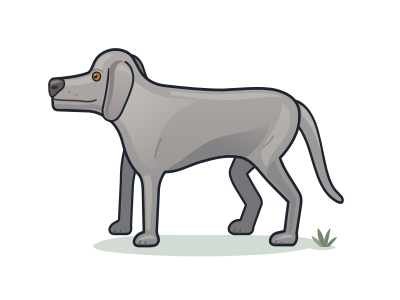
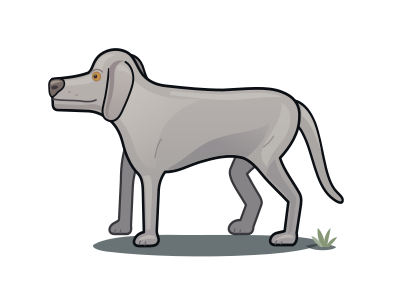
A typical adult has long legs, a deep chest and a muscular body slightly longer than it is tall. The muzzle is long and strong, and the broad ears hang down with rounded tips. Most have a smooth, close coat in shades of grey, from silvery to warmer tones. Some have long hair. The natural tail hangs low at rest and narrows towards the tip.
This exhibit shows part of a group that a DNA study found, including the German Shorthaired Pointer, the Vizsla and several setters. The branches show similarities in the DNA of the dogs studied. They do not identify one breed as the direct ancestor of another or date breed splits. Crossbreeding can connect breeds on different branches.
Origins
The German breed club traces the modern breed in its breeding records back to 1891. That date tells us how far back those records go, not when the first grey hunting dogs appeared.
Original purpose
Hunters around Weimar bred dogs to hunt deer and wild boar in the 1800s. The UK Weimaraner Association traces the breed's early history to those dogs.
Recognition
The international dog federation (FCI) gave the breed full recognition in 1954, long after the breed took shape.
Study attribution
Parker et al. (2017), Cell Reports 19:697–708 · CC-BY-4.0. Selected clade membership and nested Figure 1 relationships restated as a new, simplified diagram. No photographs, branch lengths or bootstrap values copied.
Selected facts/group membership adapted; simplified layout and illustrations by Lifetree.