A domestic breed
English Setter
Canis lupus familiaris
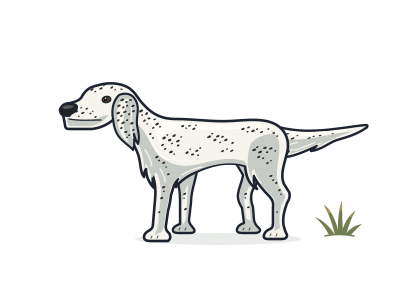
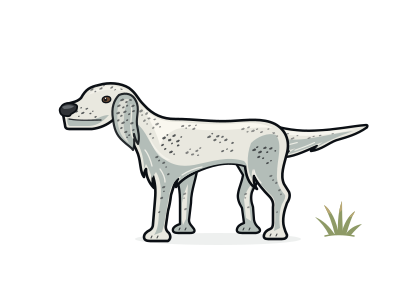
A British bird dog with a flecked coat and a silky fringe on its tail.
Branches show genetic similarity, not direct ancestors or dated splits. Crossbreeding connects different branches.
Return to the tree of life →Before there was a modern registered breed, setting dogs worked in open country such as British moorland. John Caius described a setting dog in a book published in 1570. That account shows that this kind of working dog existed then, but it does not prove an unbroken family line to the modern breed.
Look for ears that hang close to the cheeks, a long head with a fairly square snout, and a slightly curved tail with silky hair underneath. A white coat can have fine black, orange, pale yellow or brown flecks. Working dogs are often smaller and have shorter coats than dogs bred for shows.
All three setters sit in the wider pointer and setter group in this simplified version of a 2017 study. The branches show similarities in the DNA of the dogs studied. They do not tell us whether one breed helped shape another or when breeds split. Breeders have crossed dogs from different branches, but the diagram does not map those crosses.
Origins
In 19th-century Britain, Edward Laverack developed an influential line from older English setters. Richard Purcell Llewellin later crossed dogs from Laverack’s line with other dogs to develop his own line for hunting.
Original purpose
Before guns became common for this kind of hunting, setting dogs found birds and crouched to show hunters where they were. Staying low helped hunters spread their nets. That crouch, or ‘set’, gave setters their name.
Recognition
The Fédération Cynologique Internationale gave the English Setter full recognition on 6 March 1963. That is when this organisation recognised the breed, not when the breed began.
Study attribution
Parker et al. (2017), Cell Reports 19:697–708 · CC-BY-4.0. Selected clade membership and nested Figure 1 relationships restated as a new, simplified diagram. No photographs, branch lengths or bootstrap values copied.
Selected facts/group membership adapted; simplified layout and illustrations by Lifetree.