A domestic breed
Irish Setter
Canis lupus familiaris
A chestnut-red breed with roots in Ireland’s working setters
Branches show genetic similarity, not direct ancestors or dated splits. Crossbreeding connects different branches.
Return to the tree of life →The Irish breed club records that red and red-and-white working setters were bred together in 18th-century Ireland. At the time, they were not treated as the two separate breeds registered today. Irish setters worked across bogs, farmland, mountains and woodland.
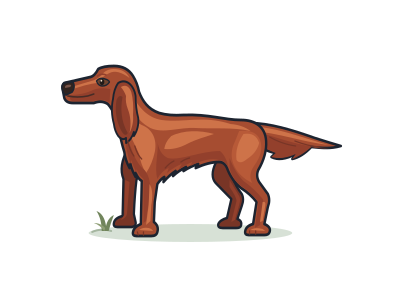
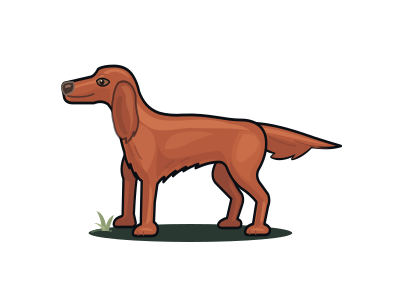
A typical adult has a deep chest, a long head and low-set ears that hang close to its cheeks. The chestnut-red coat is short on the face and the fronts of the legs. Silky hair hangs from the ears, and longer hair fringes the backs of the legs and the tapering tail.
A 2017 DNA study grouped the Irish, English and Gordon setters with other setters and pointers. The branches here show similarities in DNA. They do not show one neighbouring breed as the ancestor of another, or give dates for splits. The study also found signs of past crossbreeding between groups. This diagram does not show all those links.
Origins
The Irish Red Setter Club formed in 1882 and published its breed standard in 1886.
Original purpose
Early setters found game birds for hunters. They would crouch low to show where the birds were. This was called setting, and it let a hunter get close enough to cast a net.
Recognition
The Fédération Cynologique Internationale gave the breed full recognition in 1954. It lists the breed as the Irish Red Setter. The breed itself was already much older.
Study attribution
Parker et al. (2017), Cell Reports 19:697–708 · CC-BY-4.0. Selected clade membership and nested Figure 1 relationships restated as a new, simplified diagram. No photographs, branch lengths or bootstrap values copied.
Selected facts/group membership adapted; simplified layout and illustrations by Lifetree.