A domestic breed
French Bulldog
Canis lupus familiaris
Rounded ears, a compact build and a history shaped in France.
Branches show genetic similarity, not direct ancestors or dated splits. Crossbreeding connects different branches.
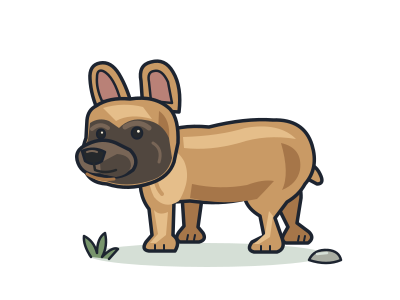
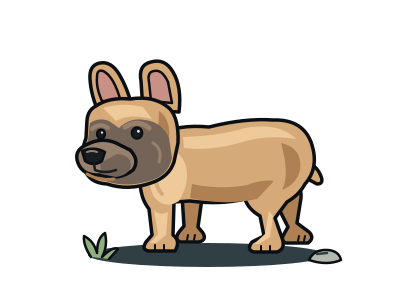
Return to the tree of life →The French Bulldog’s upright, round-tipped ears make its compact outline easy to recognise. A broad chest, sturdy legs and square head complete the picture. Its short, smooth coat can be tan, dark-striped or white with coloured patches. Some tan dogs have black colouring around the face. This is part of the coat, not a separate structure. Its characteristic short tail is natural, rather than a feature created by cutting the tail.
The Boxer, Bulldog and Boston Terrier appear beside it in this exhibit. All are domestic dog breeds, not separate species. Their positions reflect a similarity grouping from one study, not a record of parents and offspring. The diagram does not show one neighbouring modern breed turning into another. That distinction still leaves room for documented breed development using earlier dog stock. Breed history and this diagram tell different parts of the story.
Origins
The breed developed in France, with roots in small British Toy Bulldogs taken to northern France by Nottingham lace workers.
Original purpose
It was a companion dog. Early Parisian owners included market porters, butchers and coachmen.
Recognition
The American Kennel Club recognised the breed in 1898. This was a registry milestone, not the date the breed originated.
Study attribution
Parker et al. (2017), Cell Reports 19:697–708 · CC-BY-4.0. Selected clade membership and nested Figure 1 relationships restated as a new, simplified diagram. No photographs, branch lengths or bootstrap values copied.
Selected facts/group membership adapted; simplified layout and illustrations by Lifetree.