A domestic breed
Boston Terrier
Canis lupus familiaris
A compact dog with a square outline and a history of its own
Branches show genetic similarity, not direct ancestors or dated splits. Crossbreeding connects different branches.
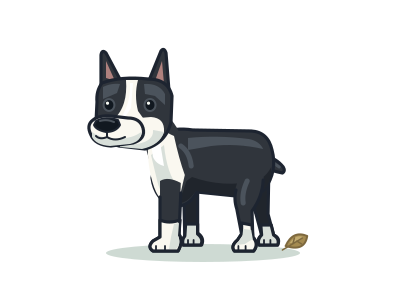
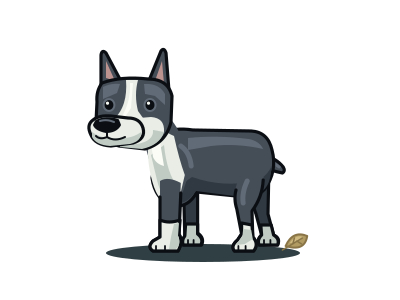
Return to the tree of life →The Boston Terrier can look like its nearby neighbour, the French Bulldog, but has a squarer outline and lighter build. This small dog breed typically has upright triangular ears, a short but broad snout and a smooth coat. Its white facial stripe and chest markings help make its appearance recognisable.
The breed club traces its development through early dogs including Judge and a white female called Burnett’s Gyp, also known as Kate. It describes Judge as an English Bulldog–white English Terrier cross. This records historical breeding, which is separate from what the neighbouring positions in this diagram establish.
Here, the Boston Terrier sits beside the Boxer, Bulldog and French Bulldog in a grouping based on genetic similarity in one study. The layout is not a breeding record. Nearby breeds are not shown as ancestors and descendants, and browsing groups are not direct ancestors. The branches give no dates or lengths of time.
Origins
The breed was developed around Boston, Massachusetts, in the United States, and takes its name from that city.
Original purpose
The established breed was developed for companionship: living alongside people as a pet.
Recognition
The American Kennel Club recognised the breed in 1893. That marks registry acceptance, not the beginning of its development.
Study attribution
Parker et al. (2017), Cell Reports 19:697–708 · CC-BY-4.0. Selected clade membership and nested Figure 1 relationships restated as a new, simplified diagram. No photographs, branch lengths or bootstrap values copied.
Selected facts/group membership adapted; simplified layout and illustrations by Lifetree.