A domestic breed
Dogue de Bordeaux
Canis lupus familiaris
A broad-headed French mastiff with a working history older than its show record
Branches show genetic similarity, not direct ancestors or dated splits. Crossbreeding connects different branches.
Return to the tree of life →Of the different kinds of mastiff once found in France, the local dogs around Bordeaux gave rise to the modern breed. The first written breed standard appeared in 1896. The breed nearly died out after the Second World War but began to recover in the 1960s. France’s national kennel club records that post-war breeder Maurice Van Cappel introduced a Mastiff into his own line.
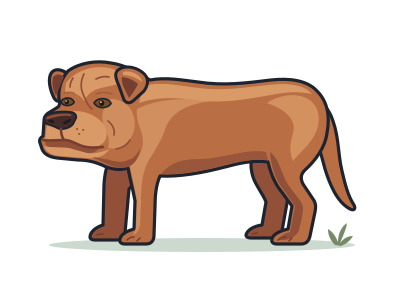
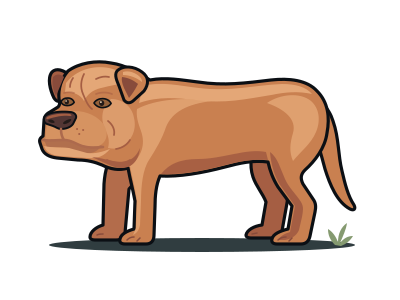
A typical adult has a deep chest and a sturdy body slightly longer than it is tall. The broad head has small folded ears and wrinkles on either side of a groove in the forehead. The snout is short and wide but still sticks out clearly. The short coat ranges from pale tan to deep reddish brown. The face can have black or brown shading, or none at all.
A 2017 DNA study placed this breed in the European mastiff group alongside the Boxer, Bulldog, French Bulldog, Boston Terrier and Bull Terrier. This diagram shows how similar the dogs’ DNA was. It does not show neighbouring breeds as ancestors or descendants of one another, or give dates for breed splits. The study also found signs of crossbreeding between groups.
Origins
By the mid-1800s, these dogs were best known in Aquitaine, in south-west France. They were shown under their current name at France’s first dog show, held in Paris in 1863.
Original purpose
These dogs guarded homes and cattle, worked for butchers and helped hunt large animals such as wild boar.
Recognition
The international canine federation formally recognised the breed in 1954. From 1 July 2008, the American Kennel Club allowed full registration and entry in the Working Group at its shows. Neither date marks the breed’s beginnings.
Study attribution
Parker et al. (2017), Cell Reports 19:697–708 · CC-BY-4.0. Selected clade membership and nested Figure 1 relationships restated as a new, simplified diagram. No photographs, branch lengths or bootstrap values copied.
Selected facts/group membership adapted; simplified layout and illustrations by Lifetree.