A domestic breed
Bull Terrier
Canis lupus familiaris
The terrier with the egg-shaped head
Branches show genetic similarity, not direct ancestors or dated splits. Crossbreeding connects different branches.
Return to the tree of life →An early Bull Terrier appeared at a dog show in Birmingham in 1862. The breed’s head shape kept changing after that. The Bull Terrier Club of America says the downward curve was added to the written rules for judging the breed in 1915.
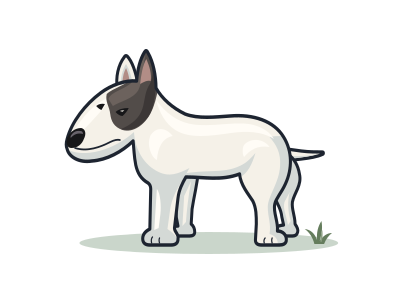
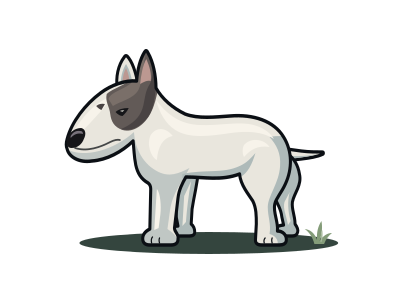
From the front, an adult’s head looks egg-shaped. From the side, it curves smoothly down to the nose. The ears are small and point up when raised. The dark eyes look narrow and triangular. The coat is short, and a white dog can have a coloured patch on its head.
The diagram places the Bull Terrier in the same broad group as the Boxer, Bulldog and Boston Terrier. Researchers called this group ‘European mastiff’. The branches don’t show that one neighbouring breed came from another, or give dates for splits. People have also crossed dogs from different branches, so the diagram can’t show the full history.
Origins
In the mid-1800s, James Hinks shaped the breed in England using older bulldog and terrier crosses. Early records also name the now-extinct White English Terrier among the dogs he used.
Original purpose
Some older bull-and-terrier dogs were used for dog fighting. The Bull Terrier Club of America describes the white dogs Hinks developed as companions and show dogs.
Recognition
The American Kennel Club first allowed Bull Terriers to be registered in 1885. The breed already existed by then.
Study attribution
Parker et al. (2017), Cell Reports 19:697–708 · CC-BY-4.0. Selected clade membership and nested Figure 1 relationships restated as a new, simplified diagram. No photographs, branch lengths or bootstrap values copied.
Selected facts/group membership adapted; simplified layout and illustrations by Lifetree.