A domestic breed
Bulldog
Canis lupus familiaris
A broad, compact dog shaped partly by the show ring.
Branches show genetic similarity, not direct ancestors or dated splits. Crossbreeding connects different branches.
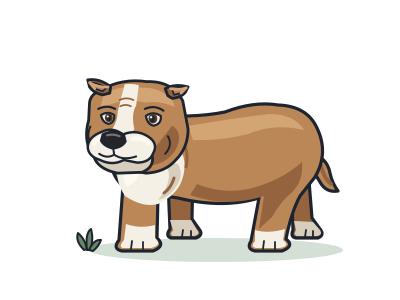
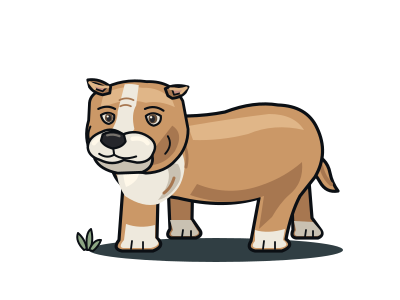
Return to the tree of life →The Bulldog has a low, broad outline, a relatively large head and a compact, muscular body. Here it sits beside the Boxer, French Bulldog and Boston Terrier within the European mastiff browsing group. These are all domestic dog breeds, not separate species.
The familiar modern form reflects documented changes in breeding. People began breeding Bulldogs for dog shows around 1860, helping shape their appearance. A Bulldog club formed in England in 1864, and another followed in 1875 as enthusiasts developed written descriptions of the breed. Those descriptions set out an ideal appearance; they do not describe every individual dog.
The study behind this exhibit compared 161 breeds. This diagram presents a simplified similarity grouping, not a pedigree. Neighbouring breeds are not shown as ancestors and descendants, and browsing groups are not direct ancestors. The layout gives no dates for separations between breeds. It also does not rule out independently documented historical crosses or development from earlier breed stock.
Origins
The Bulldog is British. Its international breed standard lists Great Britain as its country of origin.
Original purpose
Its name comes from bull-baiting, a historical spectacle in which dogs were set against bulls. Britain banned it in 1835.
Recognition
Britain's Kennel Club recognised the Bulldog in 1873. This was registry recognition, not the breed's beginning.
Study attribution
Parker et al. (2017), Cell Reports 19:697–708 · CC-BY-4.0. Selected clade membership and nested Figure 1 relationships restated as a new, simplified diagram. No photographs, branch lengths or bootstrap values copied.
Selected facts/group membership adapted; simplified layout and illustrations by Lifetree.