
A domestic breed
Boxer
Canis lupus familiaris
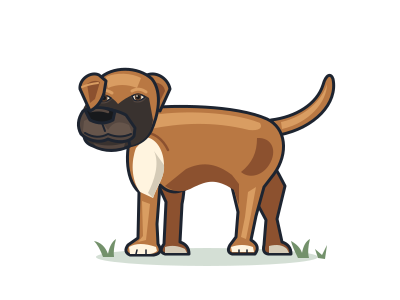
A square-built dog with a broad muzzle and a natural dark mask.
Branches show genetic similarity, not direct ancestors or dated splits. Crossbreeding connects different branches.
Return to the tree of life →The Boxer is recognisable by its muscular, roughly square body and broad muzzle. Its chest reaches about to its elbows, while its belly curves upwards towards its back legs. This is a domestic dog breed, not a separate species.
In the study behind this display, it appears alongside the Bulldog, French Bulldog and Boston Terrier within the European mastiff grouping. These neighbours help you explore similarities in DNA. Their positions do not show one modern breed as the ancestor of another. That does not rule out documented historical crosses or development from earlier breed stock. Breed history and this diagram answer different questions.
Its short, smooth coat lies close to the body. Typical colours range from pale tan to reddish brown, sometimes with black stripes. The dark colouring around its muzzle is a natural coat marking. Natural ears fold forward beside the cheeks, and a Boxer can have a full-length tail too.
Origins
The modern Boxer was developed in Munich, Germany, in the late 1800s. The first Boxer club formed there in 1895.
Original purpose
The breed's background lies in hunting dogs. Its Bullenbeisser ancestors helped hunters pursue large animals, including wild boar and deer.
Recognition
The FCI, an international federation of dog organisations, formally recognised the Boxer in 1955. This records recognition, not when the breed originated.
Study attribution
Parker et al. (2017), Cell Reports 19:697–708 · CC-BY-4.0. Selected clade membership and nested Figure 1 relationships restated as a new, simplified diagram. No photographs, branch lengths or bootstrap values copied.
Selected facts/group membership adapted; simplified layout and illustrations by Lifetree.