A domestic breed
Berger Picard
Canis lupus familiaris
Upright ears, a shaggy coat and a history alongside sheep
Branches show genetic similarity, not direct ancestors or dated splits. Crossbreeding connects different branches.
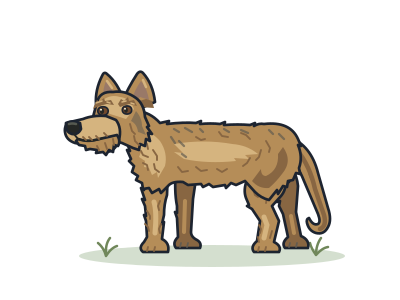
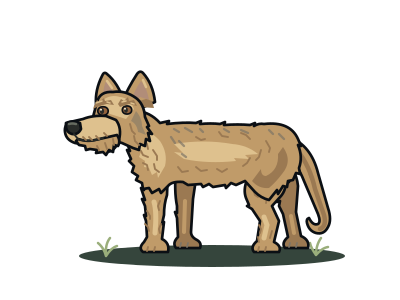
Return to the tree of life →With upright ears and a shaggy, bearded face, the Berger Picard has a distinctive outline. Its body is slightly longer than tall, with sturdy bones and lean muscle rather than bulk. Rough eyebrows frame the eyes without hiding them. A strong muzzle, moustache and beard complete the face, while its long tail ends in a slight J-shaped hook.
Its familiar form has a documented history. Paul Megnin drafted the first breed standard—a written description of the breed’s features—in 1922. After the Second World War, enthusiasts searched for dogs to help rebuild the breed. These records describe breed development, not its position in a genetic diagram.
Here it sits beside the German Shepherd Dog in a study-specific grouping based on genetic similarities. This is not a pedigree: neighbouring breeds are not shown as ancestors and descendants. Browsing groups are not direct ancestors, and no split dates or branch lengths are implied. The layout does not rule out documented historical crosses; a simple branching diagram cannot show every part of breed development.
Origins
Farmers and sheep herders developed the breed in Picardy, northern France.
Original purpose
These dogs helped keep grazing sheep within boundaries, including beside fields of crops.
Recognition
The FCI’s breed history records French recognition in 1925. Recognition marked an official milestone, not the breed’s beginning.
Study attribution
Parker et al. (2017), Cell Reports 19:697–708 · CC-BY-4.0. Selected clade membership and nested Figure 1 relationships restated as a new, simplified diagram. No photographs, branch lengths or bootstrap values copied.
Selected facts/group membership adapted; simplified layout and illustrations by Lifetree.