A domestic breed
German Shepherd Dog
Canis lupus familiaris
Pointed ears, a strong outline and a German breeding history.
Branches show genetic similarity, not direct ancestors or dated splits. Crossbreeding connects different branches.
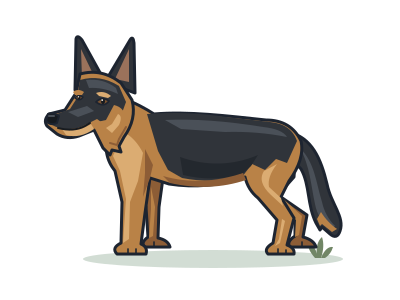
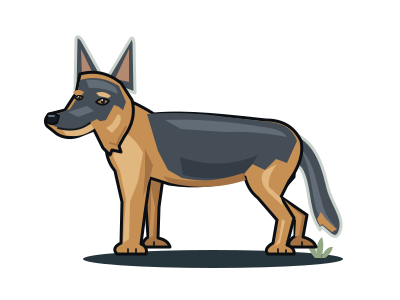
Return to the tree of life →Upright pointed ears, a substantial wedge-shaped muzzle and a muscular body longer than it is tall give this breed its recognisable outline. The ears stand naturally; they are not cropped into shape. Shorter-haired and long-haired varieties both have a layer of undercoat beneath the outer hair.
Black and tan is only one recognised colour combination. Others include solid black, black and gold, and grey. Breed standards describe a ground-covering trot: the front legs reach forward while the hind legs drive the body along.
Here, it sits beside the Berger Picard in a study-specific grouping based on genetic similarity. The diagram is not a pedigree: neighbouring breeds are not shown as parents and offspring. Nor does it show which breed was used to develop another. The “New World” label names the study’s grouping, not this breed’s country of origin.
Origins
Developed in Germany from regional herding dogs, especially those of central and southern Germany. Max von Stephanitz helped organise its development through the breed club founded in 1899.
Original purpose
It was developed for herding before becoming widely used for police and military work.
Recognition
The American Kennel Club recognised the breed in 1908. This was an American registry milestone, not the date the breed originated.
Study attribution
Parker et al. (2017), Cell Reports 19:697–708 · CC-BY-4.0. Selected clade membership and nested Figure 1 relationships restated as a new, simplified diagram. No photographs, branch lengths or bootstrap values copied.
Selected facts/group membership adapted; simplified layout and illustrations by Lifetree.