A domestic breed
Basset Hound
Canis lupus familiaris
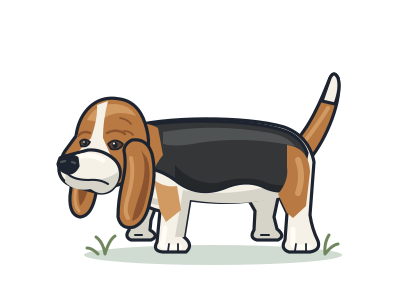
Short legs, long ears and a substantial body
Branches show genetic similarity, not direct ancestors or dated splits. Crossbreeding connects different branches.
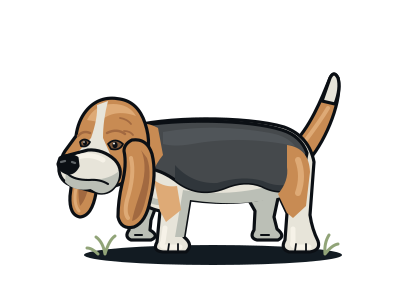
Return to the tree of life →The Basset Hound’s short, powerful legs and substantial body give this domestic dog breed an unmistakable outline. Its chest is deep, but should stay clear of the ground. Two long, soft ears hang from below eye level, with edges that curl inwards along their length.
Its short, smooth coat lies close to the body, without long fringes. Black, white and tan is one familiar colour combination, but lemon and white also occurs. The fairly long tail is thick at the base and tapers towards its tip, curving gently upwards during movement.
Here, the Basset Hound sits in a study’s Scent Hound grouping, near breeds including the Beagle and Dachshund. This is a diagram of genetic similarity, not a family pedigree. Neighbouring breeds are not shown as ancestors and descendants, and their positions do not tell us when breeds developed.
Origins
The breed has French roots. Its modern form was developed in England using imported French hounds.
Original purpose
Basset Hounds were bred to follow rabbit and hare scent at a pace hunters could follow on foot.
Recognition
The American Kennel Club recognised the breed in 1885. This was a registry milestone, not the breed’s beginning.
Study attribution
Parker et al. (2017), Cell Reports 19:697–708 · CC-BY-4.0. Selected clade membership and nested Figure 1 relationships restated as a new, simplified diagram. No photographs, branch lengths or bootstrap values copied.
Selected facts/group membership adapted; simplified layout and illustrations by Lifetree.