A domestic breed
Beagle
Canis lupus familiaris
A compact hound with a familiar face
Branches show genetic similarity, not direct ancestors or dated splits. Crossbreeding connects different branches.
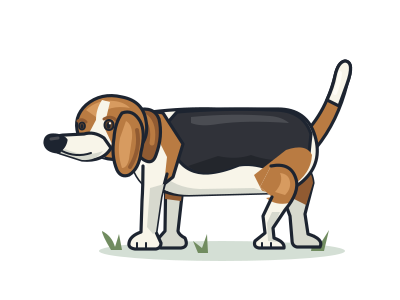
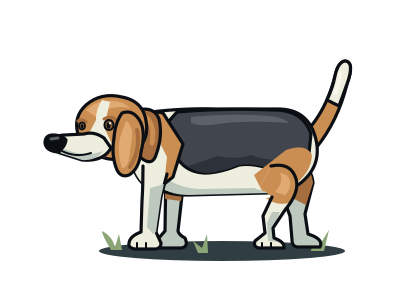
Return to the tree of life →The Beagle is a compact, sturdy dog breed—not a separate species. Its recognisable outline combines a level back, straight front legs and muscular thighs. A substantial muzzle gives the adult face its shape, while two floppy ears hang beside the cheeks.
A familiar Beagle coat combines a black back with tan and white areas, but those are not its only colours. Red and white, lemon and white, and other combinations are also recognised. The coat is short and dense. The tail is carried upright rather than curled over the back, and the breed standard calls for a white tip.
Here, the Beagle appears in a scent-hound browsing group beside Basset Hounds, Dachshunds and Redbone Coonhounds. This layout shows genetic similarities found in one study, not a pedigree. Position alone does not establish that one neighbouring breed descended from another; documented breed development needs separate historical evidence.
Origins
The modern Beagle was developed in England. Nineteenth-century breeding accounts describe work by Phillip Honeywood in Essex and Thomas Johnson.
Original purpose
Beagles were bred to hunt small game in packs, with people following on foot rather than on horseback.
Recognition
The American Kennel Club recognised the Beagle in 1885. That marks registry recognition, not the breed’s origin.
Study attribution
Parker et al. (2017), Cell Reports 19:697–708 · CC-BY-4.0. Selected clade membership and nested Figure 1 relationships restated as a new, simplified diagram. No photographs, branch lengths or bootstrap values copied.
Selected facts/group membership adapted; simplified layout and illustrations by Lifetree.