A domestic breed
Dachshund
Canis lupus familiaris
A familiar long body on short legs
Branches show genetic similarity, not direct ancestors or dated splits. Crossbreeding connects different branches.
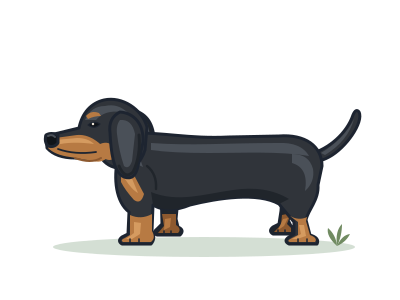
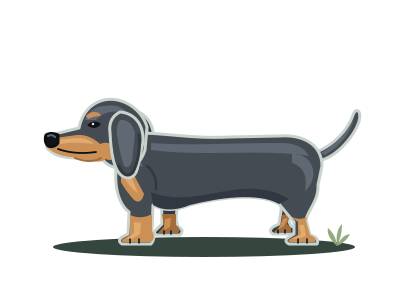
Return to the tree of life →The Dachshund’s long body and short legs make its outline easy to recognise. It is a domestic dog breed, not a separate species. Its muscular body should have space beneath the chest, rather than drag along the ground. Smooth-haired dogs have short, shiny coats, but long-haired and wire-haired forms are also well established.
Records show how people helped shape the breed’s appearance. The Dachshund Club of America describes portraits from 1836 showing all three coat types. In 1879, German breeders established a written description of the features they wanted. These records document stages in breed development, rather than a single moment when the breed began.
Here, the Dachshund appears beside the Beagle, Basset Hound and Redbone Coonhound in a study-specific grouping based on genetic similarity. This is not a pedigree: neighbouring breeds are not shown as ancestors and descendants. The study also documents mixing between breeds, so the layout should not replace independently documented breed history.
Origins
The breed developed in Germany. A dachshund-like dog was described in 1700, according to the Dachshund Club of America, but that is not a precise origin date.
Original purpose
Dachshunds were bred to hunt badgers and other small animals, including following them into burrows.
Recognition
The American Kennel Club recognised the Dachshund in 1885. This marks entry into that registry, not the breed’s beginning.
Study attribution
Parker et al. (2017), Cell Reports 19:697–708 · CC-BY-4.0. Selected clade membership and nested Figure 1 relationships restated as a new, simplified diagram. No photographs, branch lengths or bootstrap values copied.
Selected facts/group membership adapted; simplified layout and illustrations by Lifetree.