A domestic breed
Afghan Hound
Canis lupus familiaris
From Afghan working dogs to the show ring
Branches show genetic similarity, not direct ancestors or dated splits. Crossbreeding connects different branches.
Return to the tree of life →The story behind the long, silky coat begins with older working dogs in Afghanistan. Different types lived on the open desert plains and in the mountains. These dogs came before the modern registered breed, whose appearance is described in a written breed standard.
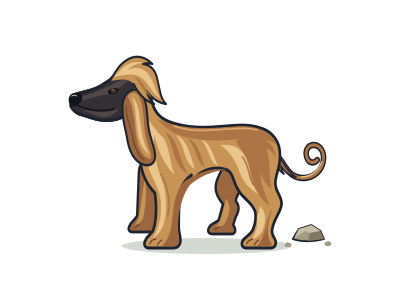
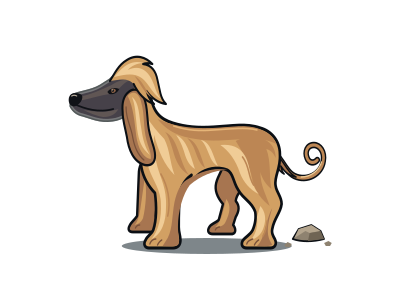
A typical adult has long hair on its hanging ears, sides and legs, but the hair along its back is naturally short. It has a long muzzle and a lightly haired tail that curls into a ring at the tip.
In a 2017 DNA study, the Afghan Hound was part of a wider group called Mediterranean, along with the Saluki, Azawakh and Sloughi. That label does not tell you where each breed came from. This diagram shows DNA similarity, not direct descent or dates for the branches. The study also found signs of crossbreeding between dogs on different branches, which this diagram does not show.
Origins
The modern registered breed took shape in Britain. Breeders crossed two early lines: the lighter-coated Bell-Murray dogs and the heavier-coated Ghazni dogs.
Original purpose
These hounds spotted prey and chased it at speed. Hunters used them to catch animals such as hares and gazelles.
Recognition
The Fédération Cynologique Internationale gave the breed full recognition on 12 December 1961. That was the organisation’s decision, not the date the breed began.
Study attribution
Parker et al. (2017), Cell Reports 19:697–708 · CC-BY-4.0. Selected clade membership and nested Figure 1 relationships restated as a new, simplified diagram. No photographs, branch lengths or bootstrap values copied.
Selected facts/group membership adapted; simplified layout and illustrations by Lifetree.