A domestic breed
Saluki
Canis lupus familiaris
A lean hunting hound with roots in the Middle East
Branches show genetic similarity, not direct ancestors or dated splits. Crossbreeding connects different branches.
Return to the tree of life →The Saluki is a domestic dog breed with roots in working hounds that people kept before kennel clubs began registering the breed. Some of the hounds that helped establish the breed in Britain came from Egypt’s Eastern Desert and the hills of Syria.
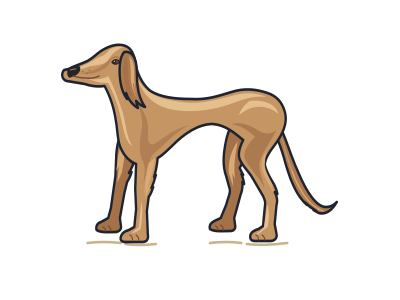
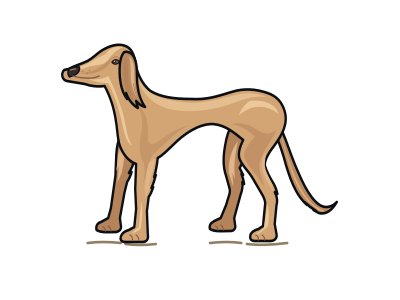
A typical adult has long legs, a deep chest and a belly that curves up towards the back legs. Its body is about as long as it is tall at the shoulder. Some Salukis have silky fringes on their hanging ears and under their tails. The smooth-coated ones have the same build without the fringes.
The exhibit shows the Saluki with the Afghan Hound, Azawakh and Sloughi in a group the 2017 study called ‘Mediterranean’. The branches group dogs by DNA similarity. They don’t show one breed descending from another or tell us when breeds split. The study found evidence of past crossbreeding between dogs on different branches.
Origins
Britain’s first official Saluki breed standard, written in 1923, made room for several regional types rather than requiring one look.
Original purpose
Bedouin hunters used Salukis to spot and chase gazelles and hares across the desert. On some gazelle hunts, the dogs followed a trained falcon until they saw the gazelle themselves.
Recognition
The American Kennel Club first accepted Salukis for registration in 1927. That was the club’s recognition year, not the year the breed began.
Study attribution
Parker et al. (2017), Cell Reports 19:697–708 · CC-BY-4.0. Selected clade membership and nested Figure 1 relationships restated as a new, simplified diagram. No photographs, branch lengths or bootstrap values copied.
Selected facts/group membership adapted; simplified layout and illustrations by Lifetree.