A domestic breed
Azawakh
Canis lupus familiaris
A long-legged working dog from West Africa
Branches show genetic similarity, not direct ancestors or dated splits. Crossbreeding connects different branches.
Return to the tree of life →The Azawakh traces its roots to working dogs from the dry country around the Azawakh Valley, near the Mali–Niger border. The breed’s traditional home also includes parts of Burkina Faso. The Tuareg, Dahoussahaq and Peul were among the peoples who shaped these regional dogs long before there was a registered breed.
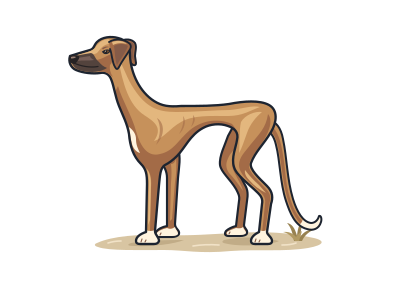
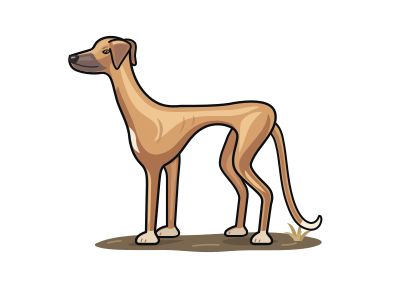
Look for long legs, a deep chest and a belly that sweeps up high behind it. The triangular ears hang close to the cheeks. At rest, the long, narrow tail hangs down with the tip slightly raised.
In France, some early imports were registered as Sloughis before the Azawakh had a breed standard of its own. On this tree, the branches show how similar the DNA of the dogs in the 2017 study was. They do not show one neighbouring breed descending from another, or give dates for splits. The study also found evidence of crosses between breeds on different branches of the wider dog tree.
Origins
Dogs that helped establish the registered breed arrived in France in the late 1960s and in what was then Yugoslavia in the 1970s. An early breeder, Renato Parigi, bred litters in Mali before continuing in France.
Original purpose
People in the Sahel kept these dogs to spot and chase game such as gazelles and hares. The dogs also travelled with families and helped guard their camps against predators.
Recognition
The American Kennel Club gave the Azawakh full recognition on 1 January 2019, when it became eligible to compete in the club’s Hound Group. That was a registry milestone, not the start of the breed.
Study attribution
Parker et al. (2017), Cell Reports 19:697–708 · CC-BY-4.0. Selected clade membership and nested Figure 1 relationships restated as a new, simplified diagram. No photographs, branch lengths or bootstrap values copied.
Selected facts/group membership adapted; simplified layout and illustrations by Lifetree.