An exploration group
Different routes to unusual coats
Selected breed-development histories
Similar coats, different genetic routes
Branches combine study-specific genetic affinities and documented breed-development histories. They are browsing groups, not a complete pedigree or dated evolutionary tree. Crossbreeding connects different branches, and similar coats can arise independently.
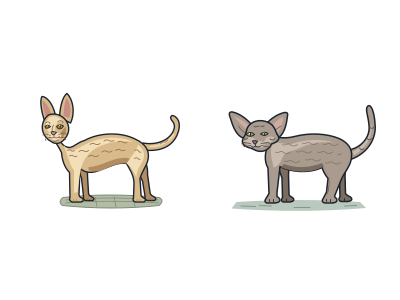
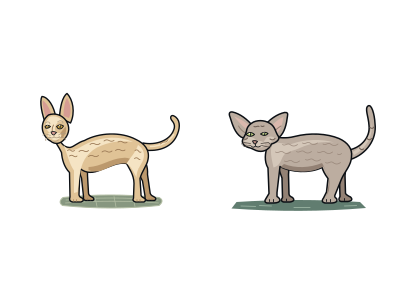
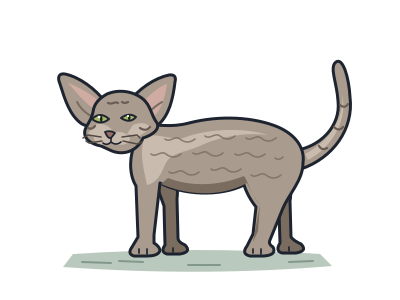
Return to the tree of life →Curly coats can look alike without having the same genetic cause. Cornish Rex, Devon Rex and Sphynx sit together here to compare unusual coats, not because they form one genetic branch. All three are breeds of domestic cat, not separate species.
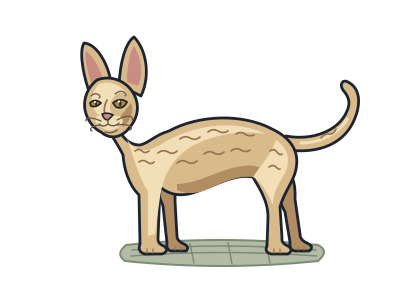
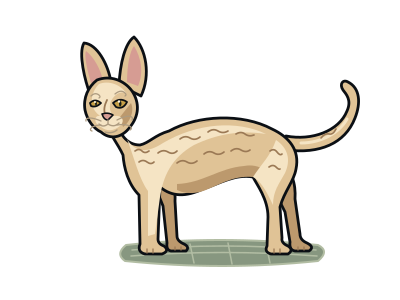
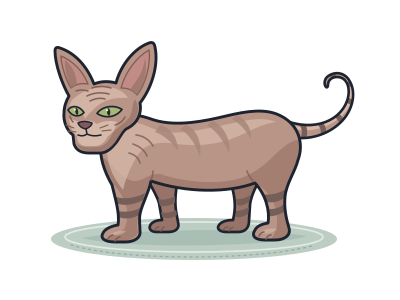
Cornish Rex and Devon Rex both have curls, but reach that look by different routes. In Cornish Rex, the coat change involves a gene called LPAR6. Devon Rex curls involve KRT71 instead. Sphynx hairlessness also involves KRT71, but a different version of that gene. Sharing a gene involved in coat traits does not show that one breed descended from the other.
The branches are a browsing guide, not a complete family record or a parent–child ladder. Breeds placed next to each other are not being labelled as ancestors and descendants. That does not rule out historical crosses: past crossbreeding helped develop the Sphynx.
Not always bare
A Sphynx can have fine down: a covering of very fine, soft hair.
Not from Egypt
The modern Sphynx has North American roots, despite its Egyptian-sounding name.
A change beyond one breed
The Cornish Rex study also found cats outside the breed carrying one copy of the coat-associated LPAR6 change.
Explore this group
Study attribution
Gandolfi et al. (2018), Scientific Reports 8:7024 · CC-BY-4.0. Original explanation of study-specific similarity; editorial group headings are explicitly not clades or geography of origin. No study photos imported.
CFA, TICA and GCCF breed histories. Original summaries of documented breeding programmes and registry distinctions. Per-page sources identify the relevant breed histories; no standards, source prose or photographs reproduced.
Gandolfi et al. (2010): Sphynx and Devon Rex mutations in KRT71. Independent factual explanation of distinct coat variants, not a breed pedigree. No source imagery or text reproduced.
Selection Signatures Reveal Candidate Genes for the Cornish Rex Breed-Specific Phenotype (2024). Factual contrast between LPAR6-associated Cornish coat and KRT71-associated Devon/Sphynx coats. No figures or measurements copied.
Selected facts/group membership adapted; simplified layout and illustrations by Lifetree.