A domestic breed
Cornish Rex
Felis catus
A curly-coated cat with a distinct breed story
These are editorial browsing groups, informed by Gandolfi et al. 2018 genetic-structure analyses. They are not rooted clades, direct ancestry, or a map of breed origins. Admixture and incomplete sampling limit every grouping.
Return to the tree of life →The Cornish Rex is a domestic cat breed, not a separate species. Its curls may remind you of the Devon Rex, but the two breeds have different inherited changes behind their coats. Historical crosses between them produced straight-coated kittens: similar looks did not mean the same kind of curl.
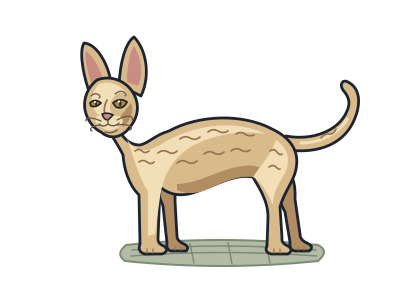
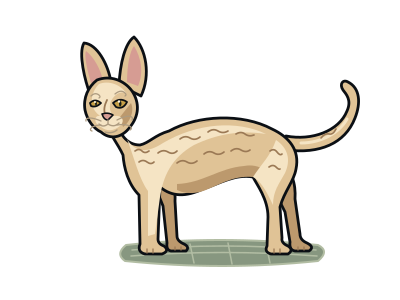
Its short, soft coat lies in close waves, so this is not a hairless cat. Curled whiskers add to the effect. Long legs, an arched back and a slender but muscular body give it a distinctive outline. The head is egg-shaped, with large, high-set ears and a gently rounded muzzle.
This branch compares different routes to unusual coats. Cornish Rex curls involve the gene LPAR6. Devon Rex curls and the Sphynx’s reduced coat involve different changes in another gene, KRT71. The three breeds are examples of coat variation, not a proposed branch descending from one curly or hairless ancestor.
Origins
The breed began with Kallibunker, a curly-coated kitten born to Serena in Cornwall, England, in 1950.
Original purpose
Early breeders aimed to preserve Kallibunker's unusual curled coat, rather than develop a particular working skill.
Recognition
The Governing Council of the Cat Fancy recognised the breed in 1967, with immediate championship status. This was a registry milestone, not its origin.
Study attribution
Gandolfi et al. (2018), Scientific Reports 8:7024 · CC-BY-4.0. Original explanation of study-specific similarity; editorial group headings are explicitly not clades or geography of origin. No study photos imported.
CFA, TICA and GCCF breed histories. Original summaries of documented breeding programmes and registry distinctions. Per-page sources identify the relevant breed histories; no standards, source prose or photographs reproduced.
Gandolfi et al. (2010): Sphynx and Devon Rex mutations in KRT71. Independent factual explanation of distinct coat variants, not a breed pedigree. No source imagery or text reproduced.
Selection Signatures Reveal Candidate Genes for the Cornish Rex Breed-Specific Phenotype (2024). Factual contrast between LPAR6-associated Cornish coat and KRT71-associated Devon/Sphynx coats. No figures or measurements copied.
Selected facts/group membership adapted; simplified layout and illustrations by Lifetree.