A domestic breed
Sphynx
Felis catus
A North American breed with a nearly bare coat
Branches combine study-specific genetic affinities and documented breed-development histories. They are browsing groups, not a complete pedigree or dated evolutionary tree. Crossbreeding connects different branches, and similar coats can arise independently.
Return to the tree of life →The cats that helped start the modern breed included Punkie and Paloma from Toronto and two kittens born to a Minnesota farm cat. Punkie and Paloma went to the Netherlands, where kittens from a cross between Punkie and a Devon Rex helped develop the breed.
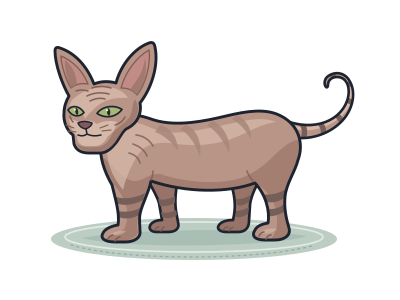
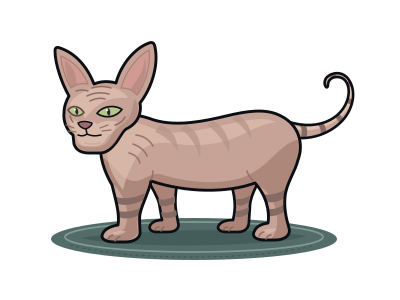
A Sphynx can look bare even when it has fine down like the fuzz on a peach. Look for large upright ears, wide-set eyes shaped like lemons and a rounded belly. The skin can wrinkle between the ears, around the muzzle and over the shoulders.
The Sphynx’s nearly bare coat and the Devon Rex’s curls are linked to different changes in the same gene, KRT71. The Cornish Rex gets its curls from a change in a different gene. The Donskoy can look bare for a different reason too. The Peterbald gets its reduced coat from the Donskoy, not from the Sphynx’s coat change.
The diagram groups the Sphynx with the two Rex breeds to compare their unusual coats. Being neighbours here does not tell you whether one breed came from another or which breeds are most closely related.
Origins
In 1966, a black-and-white short-haired cat in Ontario, Canada, gave birth to a naturally hairless kitten named Prune. He became part of an early breeding line.
Original purpose
Early breeders wanted to produce more kittens with the naturally bare-looking coat. Some kittens from those early crosses had ordinary coats.
Recognition
The Cat Fanciers’ Association began registering the breed in 1998 and admitted it to championship competition in 2002. These are milestones for that registry, not dates for the breed’s origin.
Study attribution
Gandolfi et al. (2018), Scientific Reports 8:7024 · CC-BY-4.0. Original explanation of study-specific similarity; editorial group headings are explicitly not clades or geography of origin. No study photos imported.
CFA, TICA and GCCF breed histories. Original summaries of documented breeding programmes and registry distinctions. Per-page sources identify the relevant breed histories; no standards, source prose or photographs reproduced.
Gandolfi et al. (2010): Sphynx and Devon Rex mutations in KRT71. Independent factual explanation of distinct coat variants, not a breed pedigree. No source imagery or text reproduced.
Selection Signatures Reveal Candidate Genes for the Cornish Rex Breed-Specific Phenotype (2024). Factual contrast between LPAR6-associated Cornish coat and KRT71-associated Devon/Sphynx coats. No figures or measurements copied.
Selected facts/group membership adapted; simplified layout and illustrations by Lifetree.