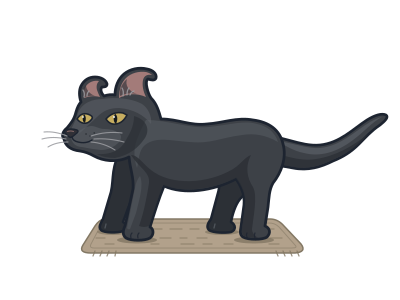
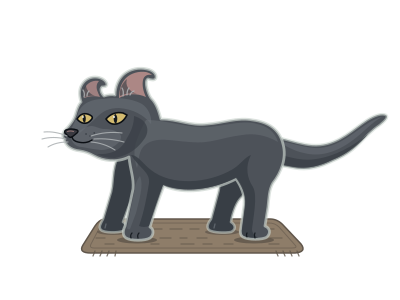
A domestic breed
American Curl
Felis catus
A cat breed known for ear tips that curl backwards
Branches combine study-specific genetic affinities and documented breed-development histories. They are browsing groups, not a complete pedigree or dated evolutionary tree. Crossbreeding connects different branches, and similar coats can arise independently.
Return to the tree of life →The American Curl’s ear tips sweep back, away from the face. A Scottish Fold’s folded ears bend forwards and down instead. The Curl’s ear shape appeared naturally: two of the founding cat’s first four kittens had curled ears like hers. Some kittens born to American Curls keep their ears straight.
Breeders paired curl-eared cats with both short-haired and long-haired domestic cats. American Curls have a slender build and come in both coat lengths. The fur lies close to the body, and the long-haired form has a full, feathery tail.
The American Curl and Bengal sit near each other on this diagram, but their breeding histories differ. The Bengal’s development included crosses between domestic cats and Asian leopard cats. The diagram groups breeds for browsing. It does not show which are closest relatives or whether one breed was developed from another.
Origins
In 1981, Joe and Grace Ruga took in a black, long-haired kitten in Lakewood, California. They named her Shulamith.
Original purpose
By 1983, breeders were choosing which cats to pair to keep the curled ears as the defining feature of a new breed.
Recognition
In 1993, the Cat Fanciers’ Association admitted the American Curl to championship competition. It was the association’s first admission of both coat lengths together as one breed.
Study attribution
Gandolfi et al. (2018), Scientific Reports 8:7024 · CC-BY-4.0. Original explanation of study-specific similarity; editorial group headings are explicitly not clades or geography of origin. No study photos imported.
CFA, TICA and GCCF breed histories. Original summaries of documented breeding programmes and registry distinctions. Per-page sources identify the relevant breed histories; no standards, source prose or photographs reproduced.
Gandolfi et al. (2010): Sphynx and Devon Rex mutations in KRT71. Independent factual explanation of distinct coat variants, not a breed pedigree. No source imagery or text reproduced.
Selection Signatures Reveal Candidate Genes for the Cornish Rex Breed-Specific Phenotype (2024). Factual contrast between LPAR6-associated Cornish coat and KRT71-associated Devon/Sphynx coats. No figures or measurements copied.
Selected facts/group membership adapted; simplified layout and illustrations by Lifetree.