A domestic breed
American Bobtail
Felis catus
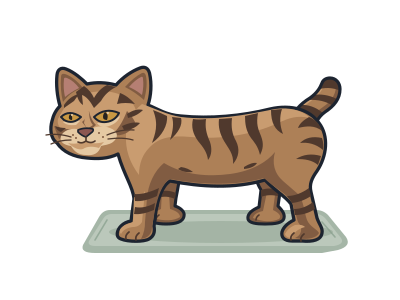
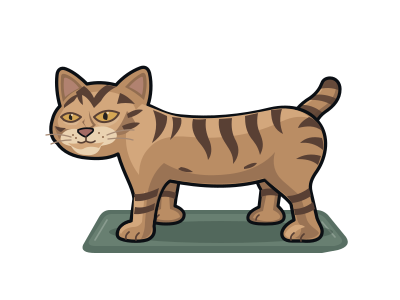
A short-tailed domestic cat with a bobcat-like outline
Branches combine study-specific genetic affinities and documented breed-development histories. They are browsing groups, not a complete pedigree or dated evolutionary tree. Crossbreeding connects different branches, and similar coats can arise independently.
Return to the tree of life →With its sturdy body and naturally short tail, the American Bobtail can look a little like a bobcat. But the resemblance is not evidence of wild ancestry. The cats described in the breed’s development were domestic cats.
Some kittens from an early pairing inherited the short tail. Breeders paired some of those kittens with a long-haired domestic cat. The modern breed did not come from just one founding cat: breeders also used naturally short-tailed domestic cats living freely in several parts of the United States and Canada.
The breed comes in two coat lengths: short and medium-long. It appears near the Japanese Bobtail, another short-tailed breed. A similar tail does not prove a shared breed history. The diagram groups breeds for browsing. It does not show neighbours as ancestors and descendants, identify the closest genetic relatives or record every cross.
Origins
Deliberate breeding began in the late 1960s after John and Brenda Sanders found a short-tailed brown tabby kitten in Arizona and took him home to Iowa. They called him Yodi.
Original purpose
Breeders chose cats with a similar build even when they came from far apart. Their aim was to keep that wild-looking shape in a domestic cat.
Recognition
The International Cat Association recognised the American Bobtail in 1989. That was a registry decision, not the year the breed began.
Study attribution
Gandolfi et al. (2018), Scientific Reports 8:7024 · CC-BY-4.0. Original explanation of study-specific similarity; editorial group headings are explicitly not clades or geography of origin. No study photos imported.
CFA, TICA and GCCF breed histories. Original summaries of documented breeding programmes and registry distinctions. Per-page sources identify the relevant breed histories; no standards, source prose or photographs reproduced.
Gandolfi et al. (2010): Sphynx and Devon Rex mutations in KRT71. Independent factual explanation of distinct coat variants, not a breed pedigree. No source imagery or text reproduced.
Selection Signatures Reveal Candidate Genes for the Cornish Rex Breed-Specific Phenotype (2024). Factual contrast between LPAR6-associated Cornish coat and KRT71-associated Devon/Sphynx coats. No figures or measurements copied.
Selected facts/group membership adapted; simplified layout and illustrations by Lifetree.