A domestic breed
Japanese Bobtail
Felis catus
Japan’s short-tailed cats were around centuries before the breed was registered in the US
Branches combine study-specific genetic affinities and documented breed-development histories. They are browsing groups, not a complete pedigree or dated evolutionary tree. Crossbreeding connects different branches, and similar coats can arise independently.
Return to the tree of life →Short-tailed cats appeared in Japanese woodblock prints as early as the 1700s, long before the modern breed was registered in the United States. US breeders favoured a lean build, and later imports from Japan brought more cats into their breeding programmes.
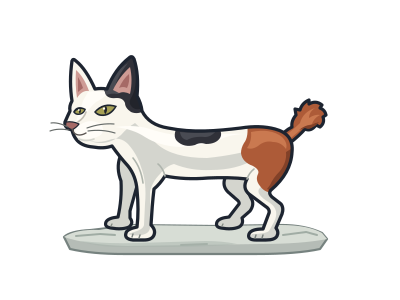
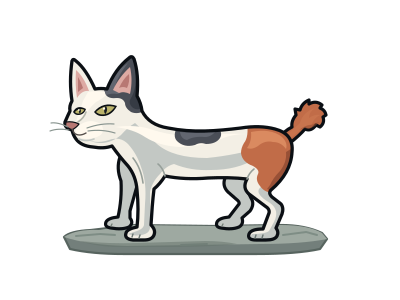
The tail is short, not missing. Its fur fans out over one or more bends, making it look like a pompom. The back legs are longer than the front legs, but they bend so the back stays nearly level when the cat stands at ease. White with black and red patches is a traditional pattern, but the breed comes in other colours too.
One study found the same change in a gene in all 12 Japanese Bobtails it tested and in some cats with bent tails from southern China. That links the tail shapes without tracing the breed’s full history. The Manx can also have a short tail, but the changes linked to its tail are different. Neighbours on this diagram, such as the American Bobtail, aren’t shown as ancestors or descendants. The layout doesn’t tell you which breed is the closest relative.
Origins
In 1968, Judy Crawford sent three kittens from Japan to Elizabeth Freret in the United States. They helped found the modern breed. Freret and fellow importer Lynn Beck wrote the first guide for judging the breed at cat shows.
Original purpose
Long before there was a registered breed, people in Japan valued cats for catching mice. On silk farms, that helped protect silkworms.
Recognition
The International Cat Association accepted short-haired Japanese Bobtails for competition in 1979 and long-haired ones in 1991. Those were show milestones, not dates when either type first appeared.
Study attribution
Gandolfi et al. (2018), Scientific Reports 8:7024 · CC-BY-4.0. Original explanation of study-specific similarity; editorial group headings are explicitly not clades or geography of origin. No study photos imported.
CFA, TICA and GCCF breed histories. Original summaries of documented breeding programmes and registry distinctions. Per-page sources identify the relevant breed histories; no standards, source prose or photographs reproduced.
Gandolfi et al. (2010): Sphynx and Devon Rex mutations in KRT71. Independent factual explanation of distinct coat variants, not a breed pedigree. No source imagery or text reproduced.
Selection Signatures Reveal Candidate Genes for the Cornish Rex Breed-Specific Phenotype (2024). Factual contrast between LPAR6-associated Cornish coat and KRT71-associated Devon/Sphynx coats. No figures or measurements copied.
Selected facts/group membership adapted; simplified layout and illustrations by Lifetree.