A domestic breed
Chartreux
Felis catus
From French island cats to a modern breed
Branches combine study-specific genetic affinities and documented breed-development histories. They are browsing groups, not a complete pedigree or dated evolutionary tree. Crossbreeding connects different branches, and similar coats can arise independently.
Return to the tree of life →In the 1920s, sisters Christine and Suzanne Léger began breeding blue-grey cats that lived around a hospital on Belle-Île, an island off Brittany. They wanted to preserve a local type of domestic cat. Their work is documented. The story that Carthusian monks founded the breed is not.
The island cats were only part of the story. In the 1930s, breeders from the Paris Cat Club crossed a Persian with a local blue-grey cat. Some Chartreux were later crossed with blue British Shorthairs. In the 1970s and 1980s, breeders paired island cats with descendants of the Paris Cat Club cats that had less British Shorthair ancestry. These pairings helped shape today’s breed.
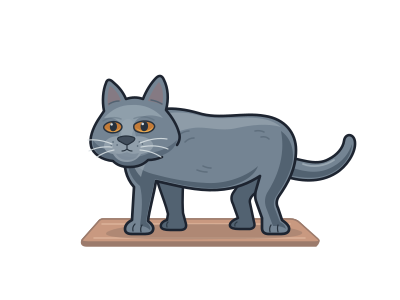
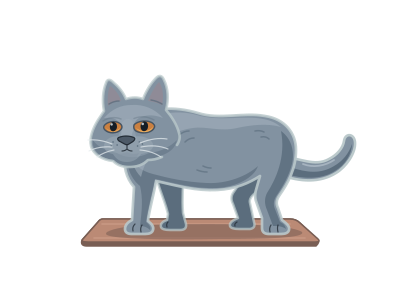
A typical adult has a dense, woolly blue-grey coat, gold to copper eyes and a muscular body with legs that look fine beside it. An adult Russian Blue typically has a leaner build and green eyes. The blue-coated British Shorthair typically has a rounder head and a crisp rather than woolly coat.
The Chartreux and Russian Blue sit in the same browsing group. That placement does not show that either breed came from the other or that they are each other’s closest relatives. The crosses with Persians and British Shorthairs are known from breeding records, not from the diagram.
Origins
In 1756, the French naturalist Buffon described blue-grey cats known as Chartreux. His account records an older French cat type, not the founding of the modern breed.
Original purpose
The earlier French blue-grey cats had a reputation for catching mice. That does not mean the modern breed was created for that one job.
Recognition
The Cat Fanciers’ Association opened registration to the breed in 1979. In 1987, it granted championship status, so Chartreux could compete for its championship titles. Neither date marks the start of the breed.
Study attribution
Gandolfi et al. (2018), Scientific Reports 8:7024 · CC-BY-4.0. Original explanation of study-specific similarity; editorial group headings are explicitly not clades or geography of origin. No study photos imported.
CFA, TICA and GCCF breed histories. Original summaries of documented breeding programmes and registry distinctions. Per-page sources identify the relevant breed histories; no standards, source prose or photographs reproduced.
Gandolfi et al. (2010): Sphynx and Devon Rex mutations in KRT71. Independent factual explanation of distinct coat variants, not a breed pedigree. No source imagery or text reproduced.
Selection Signatures Reveal Candidate Genes for the Cornish Rex Breed-Specific Phenotype (2024). Factual contrast between LPAR6-associated Cornish coat and KRT71-associated Devon/Sphynx coats. No figures or measurements copied.
Selected facts/group membership adapted; simplified layout and illustrations by Lifetree.