A domestic breed
Cymric
Felis catus
The longhaired Manx, with a Welsh name and Isle of Man roots
Branches combine study-specific genetic affinities and documented breed-development histories. They are browsing groups, not a complete pedigree or dated evolutionary tree. Crossbreeding connects different branches, and similar coats can arise independently.
Return to the tree of life →The International Cat Association (TICA) lists the Cymric and the shorthaired Manx under separate names in the same breed group. The Cat Fanciers’ Association treats the Cymric as the longhaired form of the Manx and calls it Manx Longhair.
Cymric takes its name from Cymru, the Welsh name for Wales. But its Manx roots are on the Isle of Man in the Irish Sea. Longhaired cats with no tail were found there alongside shorthaired Manx. Some registries later allowed crosses with other breeds, including in Australia, but long hair was already present in Manx cats.
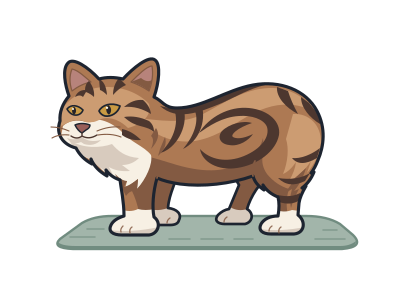
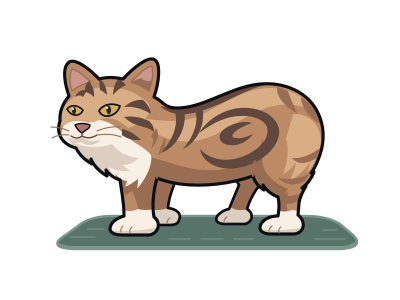
The Cymric’s back legs are longer than its front legs, so its rounded rear sits higher than its shoulders. Its thick double coat is fuller around the neck and chest and down the backs of the thighs. The adult shown here has no tail, but cats from the same breeding lines can have a short stump or a full tail.
The diagram puts the Cymric beside the Manx because of their documented breeding history. It doesn’t show neighbouring breeds as ancestors and descendants, trace every cross or establish a separate genetic branch for the Cymric.
Origins
The Australian Cat Federation records that breeder Blair Wright’s first Cymric kitten was born in 1973 to two shorthaired Manx parents.
Original purpose
Breeders in Canada deliberately bred for the longer coat to establish the longhaired Manx as a breed in its own right.
Recognition
TICA admitted both the Cymric and the Manx to championship competition in June 1979. That marks a change in show eligibility, not when either breed first appeared.
Study attribution
Gandolfi et al. (2018), Scientific Reports 8:7024 · CC-BY-4.0. Original explanation of study-specific similarity; editorial group headings are explicitly not clades or geography of origin. No study photos imported.
CFA, TICA and GCCF breed histories. Original summaries of documented breeding programmes and registry distinctions. Per-page sources identify the relevant breed histories; no standards, source prose or photographs reproduced.
Gandolfi et al. (2010): Sphynx and Devon Rex mutations in KRT71. Independent factual explanation of distinct coat variants, not a breed pedigree. No source imagery or text reproduced.
Selection Signatures Reveal Candidate Genes for the Cornish Rex Breed-Specific Phenotype (2024). Factual contrast between LPAR6-associated Cornish coat and KRT71-associated Devon/Sphynx coats. No figures or measurements copied.
Selected facts/group membership adapted; simplified layout and illustrations by Lifetree.