A domestic breed
Manx
Felis catus
A familiar cat family, with a distinctive tail story
These are editorial browsing groups, informed by Gandolfi et al. 2018 genetic-structure analyses. They are not rooted clades, direct ancestry, or a map of breed origins. Admixture and incomplete sampling limit every grouping.
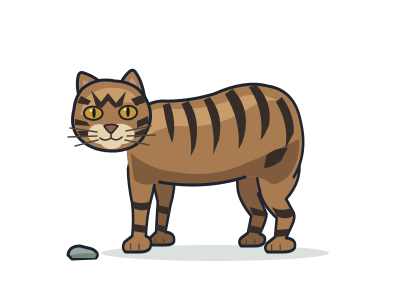
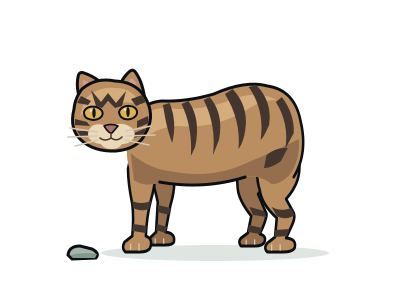
Return to the tree of life →The Manx is a domestic cat breed, not a separate species. Its familiar tailless appearance comes from a naturally occurring inherited change, not routine tail removal. Yet a Manx need not be tailless: kittens can have no visible tail, a short tail or a full-length tail.
Adults are compact and muscular, with a broad chest and strongly rounded hindquarters. Their back legs are longer than their front legs, lifting the rump above the shoulders. They come in many colours and patterns, so a missing tail does not go with just one coat colour.
The Manx sits beside the Cymric, its longhaired counterpart. TICA lists the two names within one breed group; CFA calls the longhaired form Manx Longhair. Both coat lengths occur in Manx breeding history. Their shared branch explains that connection without claiming that every cat is tailless or that other short-tailed breeds came from Manx.
Origins
The breed developed from cats on the Isle of Man. It has no known founding date.
Original purpose
Manx cats were valued as working hunters, including by farmers who needed to control rodents.
Recognition
The Cat Fanciers’ Association included Manx when it began registering cats in 1906. That marks recognition, not the breed’s beginning.
Study attribution
Gandolfi et al. (2018), Scientific Reports 8:7024 · CC-BY-4.0. Original explanation of study-specific similarity; editorial group headings are explicitly not clades or geography of origin. No study photos imported.
CFA, TICA and GCCF breed histories. Original summaries of documented breeding programmes and registry distinctions. Per-page sources identify the relevant breed histories; no standards, source prose or photographs reproduced.
Gandolfi et al. (2010): Sphynx and Devon Rex mutations in KRT71. Independent factual explanation of distinct coat variants, not a breed pedigree. No source imagery or text reproduced.
Selection Signatures Reveal Candidate Genes for the Cornish Rex Breed-Specific Phenotype (2024). Factual contrast between LPAR6-associated Cornish coat and KRT71-associated Devon/Sphynx coats. No figures or measurements copied.
Selected facts/group membership adapted; simplified layout and illustrations by Lifetree.