A domestic breed
Swedish Vallhund
Canis lupus familiaris
A short-legged Swedish farm dog with an Icelandic neighbour on the tree
Branches show genetic similarity, not direct ancestors or dated splits. Crossbreeding connects different branches.
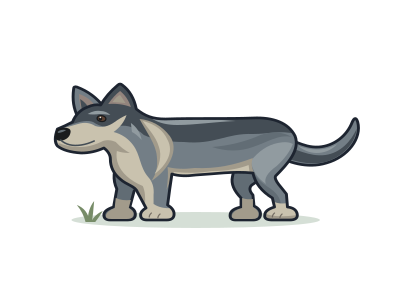
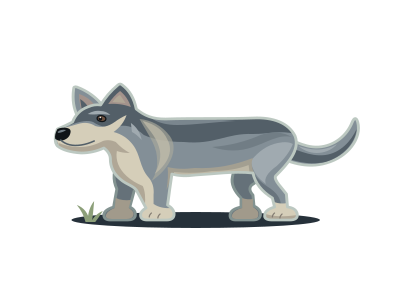
Return to the tree of life →This sturdy breed has short legs and a body longer than it is tall at the shoulder. Its ears stand upright and come to a point. Its snout narrows towards the nose and ends in a blunt tip. Paler patches on the cheeks and shoulders can stand out against darker fur along the back. Dogs can be born with a full-length tail or a naturally short one.
Researchers compared DNA from dogs of about 160 breeds. They placed this breed and the Icelandic Sheepdog in a group called Nordic spitz. The branches here show DNA similarities. They do not show one breed descending from the other or give dates for splits. The study found signs of past crosses between some breeds on different branches, but this diagram does not show which breeds crossed.
Origins
In the early 1940s, Björn von Rosen and K. G. Zetterstén found a few local dogs of the old type in Västergötland, especially on the Vara plain. Zetterstén started a breeding programme with dogs of that type.
Original purpose
On farms, these dogs helped move cattle. They rounded up the animals and nipped at their heels to get them moving.
Recognition
The American Kennel Club opened registration in March 2007 and admitted the breed to Herding Group competition that June. Those dates mark kennel club decisions, not the breed’s beginnings.
Study attribution
Parker et al. (2017), Cell Reports 19:697–708 · CC-BY-4.0. Selected clade membership and nested Figure 1 relationships restated as a new, simplified diagram. No photographs, branch lengths or bootstrap values copied.
Selected facts/group membership adapted; simplified layout and illustrations by Lifetree.